Chronicles of the Axis Empire 🪖

This is my first AAR, I hope you enjoy it. Let me know what do you think! I’m playing on version 2.7.1. Default settings, Real stars, 25% Research speed. 1 Npr, Raider after 3 systems. First post is to summarize Empire and the last 27 years. After that I’ll make more detail reports about industries, colonies, single engagments or interesting events.

AAR – Axis Empire

The Age of Expansion (1933–1960)

In 1933, with the decisive victory of the Axis powers on Earth, a new era for humanity began. Germany, Italy, and Japan, united under a common vision of order and dominance, laid the foundations of what would become the Axis Empire: a civilization destined not only to rule its homeworld, but to expand among the stars.

In the aftermath of the 1933 victory, a discovery of extraordinary significance altered the trajectory of human history. In Italy, authorities came into possession of a mysterious extraterrestrial craft — later associated with what would become known as the Magenta Incident (1933). Hidden from the world and studied in secrecy, the object represented technology far beyond contemporary human understanding. It was the Italian scientist Guglielmo Marconi who ultimately succeeded in unlocking key aspects of its design.

The breakthroughs derived from this reverse engineering effort accelerated technological progress dramatically, enabling rapid advancements in propulsion, energy systems, and materials science. What would have taken centuries was achieved in decades, laying the foundation for humanity’s expansion beyond Earth, first into the Solar System, and eventually into the wider galaxy.

Magenta Incident (1933). An unidentified craft crashes on rural farmland in northern Italy. Fascist officials and scientists, under the direction of Mussolini’s regime, secure the site and begin the first secret investigations in Monte Soratte (Roma)

Magenta Incident (1933). An unidentified craft crashes on rural farmland in northern Italy. Fascist officials and scientists, under the direction of Mussolini’s regime, secure the site and begin the first secret investigations in Monte Soratte (Rome)

Over the following twenty-seven years, that ambition became reality.


Stellar Expansion

  • 44 star systems surveyed

  • Total population: 1.866 m

  • 14 active colonies and dozens of mining outposts

  • Naval tonnage: 539.000

  • Population expanded beyond Earth, with major population centers in systems such as Procyon, V577 Monoceri, and Proxima Centauri

Colonization, leaded by Grand Admiral General Sato Hirofumi, has been rapid, methodical, and driven by a clear industrial logic:
resource extraction, logistical development, and strategic consolidation. Earth remains the heart of the Empire — but no longer its core. Mars and Luna were terraformed, even without any minerals Axis Empire decide to install banks and financial centers to boost economy.

COLONIES2

Some colonies and Naval Admin


Baptism by Ground Fire: The Rakshas

Expansion did not come without resistance. During the early phases of exploration, the Empire encountered a hostile alien species: the Rakshas.

Conflict was inevitable.

  • 3 Rakshas-held planets conquered

  • Successful orbital and ground operations

  • Humanity’s first true interstellar military campaigns

These wars did more than secure territory, they forged something far more valuable:

a new generation of commanders, hardened by real combat on a planetary scale.


Galactic Map in 1960. Big mineral operation in 61 Hydrae. ¥ is for Gas Stations

Galactic Map in 1960. Big mineral operation in 61 Hydrae. ¥ is for Gas Stations1262×888 137 KB

The Raider Threat

Not all threats came in organized form. Throughout the expansion, multiple systems were targeted by Raiders — opportunistic and aggressive pirate forces operating across known space.

The Imperial response was swift and decisive:

  • 32 Raider ships destroyed from 1935 to 1961

  • 4–5 vessels captured and analyzed for new technology

  • Development of dedicated anti-piracy fleets

These engagements led to a clear doctrinal shift:

every Imperial system must be defended, and every incursion must be punished.

Naval and fleet composition

To secure its rapidly expanding territory, the Axis Empire established a strict defensive doctrine:

  • Every population center must be protected by at least 15,000 tons of military assets

  • Each colony is equipped with:

    • Fuel stations

    • Cargo shuttle infrastructure

    • Ordnance transfer systems

Imperial engineers developed two core classes of warships to enforce this strategy. One fast and small destroyer (Karsltad), and one small carrier for long escort and guard (Hangarina) able to deploy bombing fighters (Bombing). Here the designs

Karlstad small destroyer

Karlstad small destroyer

Hangarina small Carrier

Hangarina small Carrier

Every Hangarina can transport 5 Bombing fighters (400 ton each)

image

Bombing fighter (400 tons)


Incredible Discover

In the early 1940s, ruins were discovered on V577 Monoceri-A II, where a major logistics research facility was soon established, granting a significant +50% efficiency bonus. However, the most remarkable discovery was a cache of rare alien military artifacts. After extensive study, we managed to recover several Particle Beam-6 systems, a number of Xi Shield S400/R600 units, and two Particle Lance-24 weapons.

This extraordinary technology, likely originating from an ancient and highly advanced civilization, was quickly integrated into our shipbuilding programs. As a result, we constructed two new cruisers and eight fast corvettes, which proved particularly effective against Raider forces thanks to their superior speed and the long-range capabilities of the Particle Lance systems.

Corvette P-Beam class.

Corvette P-Beam class

The Renegade-class, in particular, quickly earned a fearsome reputation

image

Cruiser Renegade with alien tech installed

kills

Killboard as November 1961

By 1961, a number of commanders had emerged as heroes of the Empire, distinguished by their courage, resilience, and unwavering bravery in the face of the enemy and for exploration merits.

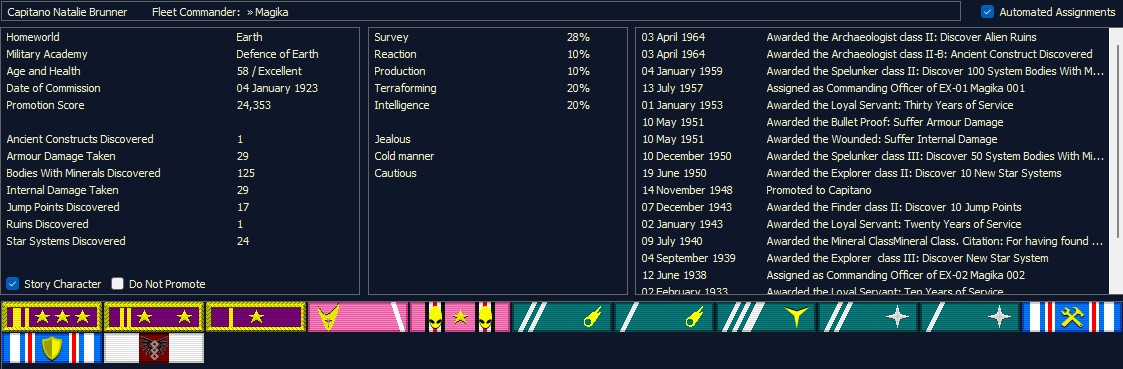
Capitano Natalie Brunner (after her was named Brunner Outpost in 86 Geminorum II)

Capitano Natalie Brunner of Magika 001

Capitano Natalie Brunner of Magika

Captain Brunner commands Magika fleet, one of the first survey vessel to operate beyond the Sol system. Under her leadership, the ship has discovered numerous valuable mineral deposits and rare planetary bodies. She also survived a Rakshas attack while operating near a colonial outpost, further cementing her reputation.

Her record speaks for itself:

  • 123 celestial bodies surveyed with mineral discoveries

  • 16 jump points discovered

  • 22 star systems explored

The Magika 001, under Captain Brunner’s command, has traveled farther than any other vessel in Axis human history and has already become a legendary ship of the Empire.

image

Speaking of combat awards, Captain Arkadiy Filippov, commander of the Corvette P-Beam stationed in the Tafel-Stromberg system, has been credited with the destruction of three enemy ships (31,578 tons) and numerous additional combat distinctions. For his actions, he earned the “Hero of the Nation” medal, becoming the first recipient of this prestigious honor.

Akradiy Filippov, commander of Corvette P-Beam

Akradiy Filippov, commander of Corvette P-Beam

35 years old Capitano Inoguchi Masaari (Renegade Mk.3 002) scored even more victories (7 ships destroyed), and 84.228 military tonnage destroyed.

Capitano Inoguchi Masaari

Capitano Inoguchi Masaari

Lieutenant Takahiro, aged 37, also deserves special recognition. As commander of the Guerriera, a fast corvette built with alien technology, he has rendered outstanding service against Raider forces, destroying three enemy ships for a total of 42,084 tons.

Takahiro

Tenente Takahiro, hero of young Axis students

Talking about ground forces, we can’t forget veteran Sergente Walter Gerrich. Hero of boarding activities with 6 succesful Boarding Combat. In service since 1933.

Navy ranks:

  • Ammiraglio ADM
  • Vice Ammiraglio VADM
  • Commodore COMM
  • Comandante COM
  • Capitano CAP
  • Tenente TNT
  • Cadetto CDT

Ground Force ranks:

  • Generale
  • Colonnello
  • Tenente Colonnello
  • Maggiore
  • Lungotenente
  • Maresciallo
  • Sergente

:brain: Imperial Doctrine

After 27 years of expansion, the ideological direction of the Empire is unmistakable:

  • Aggressive expansionism

  • Increasing militarization

  • Implicit belief in human supremacy

Logistic is setup, minerals are coming on earth and despite the industries are growing up, fuel is not a problem (for now), thanks to 11 gas stations (check system map above)

On the Edge of a New Era

By 1960, the Axis Empire is no longer a planetary civilization.
It is an emerging interstellar power, forged in war and driven by industry.

Yet questions remain:

  • Were the Rakshas only the beginning?

  • Are the Raiders truly a minor threat?

  • What lies beyond the still-unexplored systems?

One thing is certain:

the expansion will not stop.

7 Likes

Raid in Luhman 16

On December 12th, 1960, at 21:25, an alarm sounded at the Alien Activity Monitoring Center on Luhman 16 B-1. Back in the 1940s, Axis Empire had installed a tracking station on this inhospitable and barren world. For the first time since its activation, the system detected hostile activity.

A single enemy destroyer, identified as XX Niobe 013, belonging to the Raider faction, was detected at a distance of approximately 12 million kilometers from the planet, traveling at 5,848 km/s.

The vessel was immediately classified by Earth Command as hostile, a Raider scout, likely scouting for vulnerable colonies or civilian traffic to kill.

The Luhman 16 system, located just 1 jump to Sol, contains no colonies or mining operations. However, it serves as a critical transit corridor for cargo vessels and colonization routes.

Securing the system was therefore an immediate priority.

21:25 of 12 december, Raider scout contact in Luhman 16

Scramble Order

At 21:35, a dispatch from Solar Command ordered the immediate deployment of Karlstad Fleet α T, under the command of Tenente Leonhard Seeling, aged 37, with no prior combat experience.

The fleet consisted of three Karlstad T-class destroyers, a modified variant of the standard Karlstad design.

Unlike the conventional model, the Karlstad T was equipped with:

  • 10 fixed box launchers (size 24)

  • Capable of firing 10 :club_suit: Capital Torpedo-24

  • High strike payload

Together, the three ships could unleash:

30 Capital Torpedoes — equivalent to 720 nuclear warheads

However, this firepower came with a critical limitation:

Once expended, the ships required a full return to port for rearmament.

As a precaution, two Renegade-class cruisers equipped with alien tech were also ordered to move toward Luhman 16, in case additional hostile forces were present.

While Imperial forces were en route, the Raider vessel XX Niobe 013 approached the monitoring outpost, entered orbit, and landed on the planet. Curiously, it did not engage the installation.

The behavior suggested a reconnaissance operation, possibly investigating the barren and uninhabited world.

After approximately 7 hours of travel, at 04:51 on December 16th, Imperial forces reached the Luhman jump point.

  • Karlstad α T entered the system first and rush to the contact

  • Active sensors remained offline during approach

  • The Renegade fleet was ordered to hold position at a central waypoint

As the Karlstad destroyers closed in, the enemy vessel detected their presence and attempted to disengage.

At thermal sensor range, Tenente Seeling gave the order:

Turn on Active Sensors. Prepare torpedo launch.

Only one Karlstad T of the three was ordered to fire the opening salvo.

  • 10 Capital Torpedo-24 launched

  • 2 penetrated hits confirmed

Despite the low hit rate, the impact was sufficient to cripple the enemy engines, reducing its speed to 2,924 km/s.

Seeling immediately ordered a second volley.

:collision: Kill Confirmed

With the target slowed, hit probability increased dramatically (97%).

  • 10 torpedoes launched

  • 9 direct hits

The Raider destroyer was completely annihilated, engulfed in a massive explosion and destroyed in open space.

Promising 23 years old Tenente Yaroslav Marakov, commanding officer of Karlstad T 001, was credited with the kill (his first one).

He, along with the other commanders and Lieutenant Leonhard Seeling, were awarded the:

“Raider Small Operation Award”

for the successful clearance of hostile forces in the Luhman 16 system (despite the overkill).

Operational Assessment

Imperial forces remained in the system for approximately 30 days, with no further enemy contacts. After securing the area, all fleets were ordered to return to Sol, refuel, resupply and reload torpedos. However, the operation raised important strategic considerations:

  • 20 high-cost Capital Torpedoes expended

  • only 1 enemy scout destroyer destroyed

Imperial analysts concluded that this level of firepower was inefficient for small-scale engagements.

As a result, the High Command recommended the use of the standard Karlstad-class, equipped with more quantity, and less quality. And able to shoot for longer engagments:

  • Torpedo 6 (T)

  • 8 smaller launchers (size 6)

for future anti-Raider operations is also good to use long range beam ships, able to kite enemies (look at Corvette P-Beam fitting above).

A comparative cost analysis of the two Anti Ship missile systems follows in the attached report.

AS Torpedo 6 (T). Chance to hit per speed: 3,200 / 6,400 / 12,800
AS Capital Torpedo 24. Chance to hit per speed: 3,750 / 7,500 / 15,000

Torpedo 5 is used by fighters, it’s the first AS torpedo missile designed
Missiles 1 and Missiles 0.3 are Anti-missiles, at the moment we haven’t yet tested them

1 Like

Good to see a new AAR here and welcome to the club! If I can offer one suggestion, it is to not mix ChatGPT/LLM written stuff with human written stuff. It’s pretty obvious which segments you wrote and which were written by ChatGPT and the difference is a little jarring. I would recommend to use LLMs only as a proof-reader!

Also, Italy dominating the Axis empire? That is amazing!

5 Likes

Hey @Garfunkel
I really appreciate your feedback, thanks a lot!

I actually wrote the content first in my native language (Italian), and then used AI in some parts to make it more fluent but in some part it changes style too. You’re right, next time I’ll probably use it only for translation, so I can keep a more consistent style throughout. I would like to create stories but not with tons of text, will discourage people to read it.

I love the game and how it naturally drives you to create stories. I’m already planning a few more reports about colonies, industry, and fleet composition.

Also, I’m not sure if it’s possible: but I’d like to make this AAR more interactive and involve the community in guiding the Empire’s decisions. For example, it would be great to run polls, like deciding which region of space to explore or expand into next.

I just noticed that there’s a poll tool available here on the forum, so I might try that for the next report :star_struck:

Would you like to contribute to this campaign by voting on the Empire’s decisions as the story progresses?
  • Yes
  • No
  • Not sure, I’d still read it anyway
0 voters
1 Like

Meeting of the Grand Council

May 8th, 1961. Meeting of the Grand Council of the Axis, Rome. Palazzo Venezia.
09:15. Among the most influential officers at the table we have:

Sato Hirofumi, Grand Admiral and Duce of the Axis (77 years old), in service since 1933
Jochen Scheele, Scientific Director of the Outpost 42 Laboratory (Monaceri)
Natalie Brunner, Commander of the Magika Exploration Fleet, veteran explorer
Bastian Bier, Admiral of Naval Control
Mayuzumi Kiyotsuna, Captain, Operational Director of Industrial Operations
Renzo Bersanti, Freight Transport Command
Sasaki Buntaro, Governor of Outpost 42 Logi Lab at Monoceri-A II
Svyatoslav Timofeyev, Governor of Dwarf Colony at Alpha Centauri - A III
Andrea von Aulbach, Governor of the Sol Sector

note: no IA used for this narrative text

The great hall of the Axis Council is composed of white marble walls, with wide and tall transparent windows that let the morning light stream in bands. The twelve delegates of the Grand Council of the Axis take their places in the spacious chamber, sitting around the large oval table. They are all waiting for the signal from the Grand Admiral, the Duce, to begin proceedings

At the head of the table sits Sato Hirofumi, Grand Admiral and Duce of the Axis, 77 years old. For years there had been rumors of a succession due to his health problems, yet the Duce still appears highly focused, never granting too much familiarity to his officers, and in his decisions, since the beginning of the Era of Expansion, he has always appeared wise and resolute. The people trust him also because in these 28 years of rule he has never faced any open crisis, neither military, nor economic, nor diplomatic. Hirofumi is admired and respected as well by his officers. The Duce Hirofumi stands a great transparent window that fully reveals the Colosseum. An immense monument still intact, symbol of a civilization of centuries ago, from which the Axis draws inspiration, once an arena of epic battles among Terrans.

“Ave, councillors. Our meeting may begin.” “First of all, I would like to hear the report from the Director of the Monclave laboratory, Jochen Scheele.”

Scheele, 49 years old with over 122 scientific works on his record, clears his throat: “Ave Duce, our research is proceeding very quickly. As requested we have already researched and developed projects for the new radars, thermal radar models and Marconi active sensors are ready to be installed on our frigates.” “Larger Gamma shields compared to previous ones have also been developed and can be used. We are also working on the first automatic anti-missile defense systems (Cisw-60) and new, larger holds for missile transport on ships.”

“Thank you Mr Scheele, I would like to know instead the status of the designs for the new ships. Mr Razan, have you handled this?” “Yes, Duce,” replies deferentially Kajwara Razan, chief scientist of the Propulsion Division and director of new ship projects. “We have already transmitted the new designs for the Karlstad Mk2 and for the single Guerriera Mk2. The Beam Corvettes can also be upgraded to the new version. The ships will mount new missile targeting systems with greater range. The newly designed Marconi sensors will be fundamental to detect more precisely and in time raids on the colonies by Raiders. We have also worked on new ship concepts, they are only ideas on paper for now, we worked on new destroyers, cruisers and a battleship. We await guidance from the Council.”

Defense ships, distribution between the Solar System and other colonies.
Report made by Commodoro Connor Barry and Commander Liv Lundstrom

Fleet defence in May 1961

Defense Fleet – Sol
1 Frigate Carrier Hangarina (9,400 tons), 11 Frigates Karlstad (76,000 tons total), 2 Cruisers Renegade (72,000 tons total), 1 Commercial Carrier Asmara (32,000 tons), 1 Stationary Hangar Base (19,500 tons)
Total Fighters: 43 R-Wing II, 4 Pathfinder, 5 FAC Boarding B-2, 4 Fighter Tankers, 6 Torpedo Fighters

Defense Fleet – New Delhi (Procyon System)
4 Corvettes P-Beam (17,000 tons total), 1 Frigate Carrier Hangarina (7,800 tons) + 4 Bombing Fighters

Defense Fleet – Monaceri
2 Corvettes P-Beam B-2 (8,500 tons total), 2 Frigates Karlstad (14,000 tons total)

Defense Fleet – Outpost 61 (61 Hydrae System)
2 Frigates Karlstad (14,000 tons total), 1 Frigate Guerriera (9,900 tons), 2 Frigate Carriers Hangarina (18,800 tons total) + 8 Bombing Fighters

Defense Fleet – Iogawa (Proxima Centauri System)
3 Frigates Karlstad (21,000 tons total), 1 Frigate Carrier Hangarina + 4 Bombing Fighters

Defense Fleet – Capri (DX Cancri System)
4 Frigates Karlstad (28,000 tons total), 1 Frigate Carrier Hangarina (7,800 tons) + 4 Bombing Fighters

Fleet – Tafel-Stromberg (Gamma Carinae System)
2 Corvettes P-Beam (8,500 tons total)

Defense Fleet – Luytens
2 Frigates Karlstad (14,000 tons total)

Defense Fleet – Lambda Reticuli (Comet 6 Escort)
1 Frigate Carrier Hangarina (7,800 tons) + 4 Bombing Fighters

Defense Fleet – Brunner Outpost (Geminorum System)
1 Hangarina (7,800 tons) + 4 Torpedo Fighters

Ships total: 393.800 tons
17 Karlstad (frigate)
5 Karlstad Anti Missile (frigate)
3 Karlstad Torpedo (frigate)
8 Hangarina (carrier frigate)
8 Corvette P-Beam (corvette) *with alien tech
1 Asmara carrier (carrier)
1 Hangar base (static carrier)
1 Guerriera (frigate) * with alien tech
2 Renegade (cruiser) *with alien tech

Fighters-Fac: 41.700 tons
Total Defence Navy Tons: 435.500 tons

Total survey fleet
9 Survey ships Magika of 106.200 tons

New caetgory convention name
500: Fighter
1000: FAC
1000 to 5000: Corvette
5000 to 10000: Frigate
10000 to 15000: Destroyer
15000 to 25000: Cruiser
25000 to 40000: Battlecruiser
40000 to 100000: Battleship

New frontiers
“Thank you Mr Razan, I’ll take a look at the reports. We will soon take a decision on how to develop our defensive and offensive fleets”. Now I would like to know where we stand with exploration and whether we have news from the southern and northern borders of the maps. Captain Brunner?"

“Good morning Duce, always at your service.” Captain Natalie Brunner in full naval uniform has a youthful appearance despite her 55 years. Slender figure, icy blue eyes, she keeps her blonde hair tied behind her head. Medals and decorations gleam on her chest. Her voice is very soothing. “We have explored the systems around the Draconis region, in the south of the Empire. To the north there is the possibility of pushing beyond ‘70 Eridani’. None of our exploration fleets has encountered opposition, nor neutral life forms. From the data we have, the southern cluster seems more promising, both in terms of gas and minerals. We await your order on how to proceed.” Brunner hands the new map to the Duce, who takes it, observing it

“Very well, thank you very much. Certainly Pi Ophiuchi must be completely colonized. And the western side also still seems unmapped. We could also go beyond Omega Ceti. For the moment we must strengthen and consolidate the population in our young colonies. We will not stabilize other jump points except to reach exceptional planets, it is too risky to leave too many access gates open. Only after consolidating ourselves will we be able to think of expanding. Exploration must not stop and neither must the research of new ships. We cannot think of having fleets made only of frigates and corvettes”

“Kiyotsuna order new mining and gas extraction stations. We will truly need them. What is the current situation?”

“Honor to the Duce”. Mayuzumi Kiyotsuna hold many paper in his hands. “Gas extraction operations are proceeding well. We have 7 stations at Proxima Centauri III, 3 at Hydrae, 1 at Geminorum. We produce about 25 million fuel per year.” “I guess we can reach at least 40 million of fuel per year”. “The main mining operation is at Hydrae, with a fleet of 11 extraction ships. But resources are gradually declining. In the Solar System we have 5 stations working full speed at Von Biesbroeck. One station had been lost two years ago during the assault of the Red March, but we replaced it already. Then there is Operation Comet 6 at Lambda Reticuli, the incredible recovered alien station manages to extract many minerals. We bring a lot of material on earth, who knows if one day we will be able to build a similar marvel. Here is our mining situation Admiral, and the extraction fleets disposition”. The Duce takes the documents and analyzes them carefully before to speak again.

“Bersanti, it is your turn. Tell me how logistics between colonies and fuel transport are proceeding.” “Honor to the Duce, we have 4 tankers that each year bring gas to the ports. A tested and efficient system. Another 3 tankers on standby in case of emergencies, shortages, or support to fleets. But for now our frigates do not consume much, apart from the two Cruisers, Renegade, with alien technology. Regarding transport, the Cargo ships have almost completed the transport of a spaceport to Pi Ophiuchi II, where we already have nearly 7 million citizens. The salvager ships have returned with the remains of the last raider destroyed at Luhman 16, the two Tugs are ready if needed to move new stations”.

“Very well. We must now take stock of terraforming works. It is necessary to proceed quickly, otherwise we will not be able to start production outside Earth, and we will have a shortage of colonists. I need to know from you, Buntaro, how things are progressing at Outpost 42, at Monoceri?”

“Duce, we have 65 terrestrial terraforming units. We are adding Aestesium gas to raise temperatures. Oxygen is already at optimal level, but we must bring the total below 30%, it is now at 31.2%. It will take several years, perhaps 3, 4 years. We are proceeding at maximum speed.” “Timofeyev, what can you tell me about Alpha Centauri - A III, it has been 5 years since you began terraforming the dwarf planet. I expect results soon. Alpha Centauri must become our outpost in the north.” The young Timofeyev, 31 years old, trained at the Governors’ Academy of Luna, has a typical lunar accent that reminds everyone of Russian.

“Duce, we are currently limited by the number of colonists, we lack 2.5 million workers to reach 100% efficiency. Fortunately the planet is small, the 24 terraforming platforms are working day and night. We are adding oxygen while the water vapor is gradually condensing, soon we will have sufficient water. I believe that in two years, if we bring more colonists, we will be able to terraform the planet”

“Good, carry on. Then we will have to continue terraforming other bodies in Alpha Centauri, we just have to move installations, and then it will be the turn of Iogawa, we need mines there and I want more workers available.” Hirofumi pauses for a long reflective moment, stands up from his chair placing both hands on the table. “The meeting of the Grand Council may be considered closed for today.” “We now proceed to the voting phase. I ask you gentlemen to indicate your preference on government priorities. Once the vote is cast, I will review the results, study all your reports and update you via holograph with more specific orders. Thank you all, you may vote and return to your duties. Ave”

The officers stand and salute: “Ave”, then begin to press several keys on the meeting table, meanwhile the Grand Admiral has already turned his back, he is leaving the hall with a slow pace, before opening the door he casts a glance to his right, toward the large window where the Colosseum stands.

What is the indication from the vote of the Grand Council?
  • Focus on aggressive border exploration build new Magika ships
  • Focus on producing defensive fleets of destroyers and cruisers
  • Produce more terraforming modules, consolidate existing colonies
  • Produce more mining and gas stations and stockpile minerals and gas
0 voters

Be part of the story
*note: anyone who votes or reads this AAR may ask me to impersonate a character within the story, your character will become part of the narrative and will appear in events and other reports. Reply to this post or send me a message with your character name (be coherent with the story, let me know name and surname) and chosen role. You can choose from:

-fighter pilot defence (Bombing or R-Wing)
-fighter pilot logi or scout pilot (Pathfinder or Tanker)
-cargo pilot
-troop transport pilot
-young colony governor
-salvager pilot
-tug pilot
-gas station commander
-mining station commander
-mining ship pilot
-young scientist
-young ground force commander

as your character gains experience, you may be promoted and eventually take command of a proper warship, and maybe one day partecipate to the Ground Counsil of Axis!

5 Likes

Push the Boundaries

Axis Empire continues its expansion toward the most distant frontiers. The three Magika exploration fleets, composed of 9 ships in total, have been reinforced with two new exploration vessels that will operate independently. The Council’s vote was clear: it was necessary to invest in finding new resources, deciphering the mysteries of the universe, and bending them to our advantage.

The two new Magika ships will be deployed at the borders: one in Alpha Centauri, where the population can now support ships up to 70,000 tons, and the other in the deep south, beyond 81 Draconis, as soon as the new colony is able to host adequate maintenance facilities. These two exploration ships will be based directly in these new colonies. The other Magika fleets will also be gradually assigned to the most remote frontiers, to the East and to the West.

Total Magika exploration ships: 11 + 7 scout fighters (128,000 tons total)

August 30th, 1962 – Incredible Discovery in WX Ursae Majoris

Captain Moa Berglund, commanding the Magika γ fleet, and her men have just discovered a jump point in Iota Ursae Majoris, on the south-eastern edge of the known maps. Despite limited supplies and scarce fuel, Berglund orders the fleet to make the jump and take a look at the unexplored system.

The sensors immediately reveal a place rich with celestial bodies: more than 60 planets and moons, plus hundreds of asteroids within extraction range. The most interesting planet is Ursae Majoris-A III, barren but with the potential to be colonized.

From Astronomical Command, Commander Orlando Abbitt orders Berglund to scan the planet, search for possible ruins, and return immediately at the base for resupply. Berglund’s eyes shine as the planetary scanner reveals its results. “There are ancient ruins!”

“Go down there immediately and investigate.”

Cadet Sigrid Pommer, aboard the Pathfinder fighter with his 3 crewmembers, dives through orbit and activates the sensors. No enemy ground units are detected. The ruins appear well preserved: a partially intact colony of some unknown civilization.

Magika γ completes the scan and begins its return to Earth. The new ships under construction, or other fellow explorers, will finish the examination of this promising system.

From ground command, Admiral Duce Hirofumi is informed of the important discovery. The immediate deployment of personnel and ground forces is ordered, commanded by Maggiore Marco Skorzeny, a rude soldier but also a Xeno artifacts expert. Transport units with a jump gate ship are sent toward WX Ursae Majoris, carrying around 120,000 tons of troops on board: 70 STO air defense units, 45,000 infantrymen, 25,000 assault and defense vehicles, 10,000 constructors, and 20,000 archaeologists. Arrival is expected during the first months of 1963.

The media of the Axis report the news of the archaeological discovery with fervor and excitement; the hope is to uncover rare alien artifacts and technologies that may provide a major boost to the expansion and defense of the Empire.

September 12th, 1962 – Rats in Luhman 16. Setting traps for raiders

Another sighting of a single Raider ship in Luhman 16, showing the same behavior observed two years earlier. The Raider scout lands on the uninhabited planet. The Karlstad T and Karlstad AM fleets are immediately deployed from Earth, just 1 jump away.

After a few hours, the two ships intercept the enemy contact without difficulty. The Raider attempts to disengage, but fails. During the attack, Warhead-1 missiles are tested first, used as anti-missile weapons but still capable, when launched in mass, of penetrating unshielded and low armor hulls. Shortly afterward, a Warhead-24 is launched from the Karlstad T, striking the enemy ship’s structure and causing it to explode.

Another victory for Lieutenant Yaroslav Makarov, a twenty-five-year-old officer with a promising future: 2 confirmed victories and 21,000 tons of enemy ships destroyed.

A trap!

Given the repeated Raider activity in Luhman 16, it is decided to organize a trap. Instead of ordering the recovery of the wreck, an exploration ship (Magika) is sent to cover the surrounding area with probes and sensors. In addition to the planet’s long-range detection system, the probes deployed by Magika will now also be able to detect any enemy approach in the area.

The hope is that the wreck will attract new Raiders. Luhman 16 is easily reachable from Earth’s spaceports: as soon as the sensors detect something, new interception fleets will be able to launch and, within a few hours, make a feast of the enemy. Will the trap work?

New Terraforming Colonies. November 1962

Incredibly, both Monoceri A II and Alpha Centauri A-III (Dwarf Colony) have been terraformed! An extraordinary success for the environmental engineers of the Axis, who managed to make these two systems habitable earlier than expected.

The small planet of Alpha Centauri A-III will become a key outpost for the northern colonies: it will be able to host 59 million people and will become an excellent mining world. We just have to wait few months that Water Vapour will condense as water on soil, then the work will be done. Terraforming modules are about to be transferred to Alpha Centauri B-III, which will receive the same fate as the twin planet of star A.

On Monoceri, the population can now reach 389 million inhabitants; it will therefore be possible to strengthen research with new laboratories and exploit the logistical bonus provided by the structures discovered on the planet. Work is still ongoing on the addition of Aestusium to increase the minimum temperature, which remains too low (-63 degrees). It will probably not be possible to fully terraform the planet, as it has an irregular orbit and extremely unstable temperatures, ranging from 30 degrees down to -63.

It will, however, certainly be possible to optimize infrastructure use and drastically reduce the number of facilities required. Meanwhile, the excess housing units, both on Alpha Centauri A III and on Monoceri, have been redirected toward Alpha Centauri B-III and toward Callisto, one of Jupiter’s moons, where the Axis will attempt to create a habitable environment in order to extract the numerous, but otherwise difficult-to-access, mineral resources.

4 Likes

The Silent Frontier

May 17th, 1964. The Supreme Admiral of the Axis and Duce, Sato Hirofumi, turns 80 years old. In New Delhi, in the Procyon system, a great public celebration fills the streets and spaceports of the colony: imperial banners, military parades, official speeches, and thousands of citizens gathered to pay tribute to the man who, for more than thirty years, has guided the destiny of humanity among the stars.

Despite his increasingly fragile health, Hirofumi still appears lucid, present, and perfectly aware of the weight of his decisions. The medals and decorations gleam on his chest, the latest being The Ancient Wise Regent, awarded by the Representatives of the People for thirty years of prosperous rule, as he watches the crowd with his usual stern gaze.

Since 1933, the day plasma engines were discovered thanks to the study of the craft recovered during the Magenta Incident, every strategic decision of the Axis has passed through his hands: he organized the defense of Earth, led the first great colonial expansion, supervised the construction of the fleets, and imposed a simple but iron doctrine — always explore, always advance, but never lower your guard.

The Empire must grow, but it must also survive.

Everyone knows that Hirofumi’s time is not infinite. In the corridors of the Grand Council, people now speak openly of the future succession, yet the Duce has still not named an heir. Perhaps he is still waiting for something. Perhaps he wishes to see for himself how far mankind can push into the stars. Or perhaps it will be the people who choose.

Beyond the Raiders, the predatory race that continues to infest trade routes with swift incursions and sudden disappearances, humanity has also encountered the Rakash: a harsh, aggressive, deeply territorial species. They fought to the very last to defend three planets that now belong to the Axis. No communication, no surrender, only war.

Recently, the autopsy of a Rakash body recovered after a ground battle revealed valuable data about their habitability parameters: temperatures between -57° and +67°, oxygen levels between 0.02 and 0.29 atmospheres, and gravitational tolerance up to 2.93G. Information that tells much about a people accustomed to surviving in hostile environments.

Meanwhile, the extraordinary Magika exploration ships — now risen to 13 operational units — continue to push where no human being has ever gone. Fast, light, tireless, they have become the true symbol of the new Era of Expansion.

The latest great discovery bears the name of Captain Natalie Brunner.

In Rho Sculptoris II, west of the mapped regions, her fleet discovered ancient ruins: the remains of an unknown city, cyclopean monoliths, and structures that seem to belong to a far more advanced civilization. Some buildings resemble research laboratories, while others remain completely indecipherable.

A similar discovery also took place on the southern front, in WX Ursae Majoris-A III, where a partially intact abandoned colony was found. No fewer than 296 installations are still present on the surface and are slowly being brought back to light by teams of builders and archaeologists.

As if that were not enough, on Fomalhaut III an old alien outpost was discovered hidden inside a cave stretching for kilometers: an ancient observatory, perhaps a surveillance base, perhaps something even more important.

Archaeological units are working day and night. On Fomalhaut III, seven brigades of archaeologists and two construction brigades are already operating, protected by two infantry divisions. Another brigade will soon be transferred to Rho Sculptoris, while on WX Ursae Majoris several construction teams are already at work extracting the valuable installations. To avoid unpleasant surprises, three infantry divisions, assault vehicles, and no fewer than 76 STO orbital defense units have been deployed to protect the colony.

Every ruin could contain a technological treasure. Or a danger.

Exploration has also revealed numerous promising systems from a mining perspective: 1 Phoenicis, Fomalhaut, and several new clusters still under analysis show planets rich in resources and favorable environmental conditions for future colonization.

Meanwhile, the trap prepared against the Raiders in Luhman 16 continues to remain silent. No signals. No movement. The last recorded incursion now dates back sixteen months, to September 1962.

This reassures no one. What are they plotting against the Axis? Where will their next incursion strike?

Meanwhile, nearly all colonies continue to grow, especially the two most recently terraformed: Outpost 42 Logi, on Monaceri, and Dwarf Colony on Alpha Centauri-A III. New mines are being transferred there, along with more and more specialized workforce.

Callisto and Alpha Centauri B-III are rapidly being converted into breathable worlds. In both systems, the plan is clear: install mines, develop infrastructure, and transform them into industrial pillars of the Empire.

Great attention is also being directed toward Proxima Centauri II, where the mineral deposits are extremely promising. Once a sufficient population is reached, the massive deployment of mines could guarantee a flow of resources capable of sustaining the expansion of the Axis for decades.

The Mineral Courier ships travel endlessly from one colony to another, carrying minerals back to Earth like vital arteries of an ever-growing organism.

For now, only New Delhi and Proxima Centauri possess their own factories and continue, without interruption though still slowly, the production of housing infrastructure, industries, and new strategic facilities.

The Empire grows.

Who knows if somewhere in the universe there is other intelligent life?

Situation of resources on 1964

  • Total colonies: 17
  • Mineral stock on Earth: 1.737.980 Average stockpile 150.000 per mineral
  • Fuel on Colonies: 458.000.000
  • Mps at Colonies: 598.000
  • Naval Tonnage: 641.000
  • Naval Shipyard Capacity: 652:155
  • Commercial Tonnage: 5.500.000
  • Ground Forces: 912.157
  • AM total: 391
  • Mine: 1004
  • Terraforming Installation: 101
  • Research Facility Earth: 51
  • Research Facility Outpost 42 Logi Lab Monocery: 8

Shipyards situation on Earth

2 Likes

Disaster in Rho Sculptoris

Echo Colony, Axis Outpost - The ruins of an ancient city on Rho Sculptoris II had drawn, for months, teams of engineers, archaeologists, and construction units. Preliminary studies had identified, with reasonable certainty, the Echo civilization: symbols, language, and architectural patterns had been partially deciphered. 137 abandoned installations lay buried beneath layers of dust and rock, ready to be recovered.

Unknown machinery, intact structures, complexes that seemed to be laboratories or research centers — everything suggested discoveries of immense value.

On November 5th, 1965, as a precaution, all archaeologists were evacuated. Only construction brigades and two security divisions remained on the colony: one infantry and one armored vehicles, for a total of approximately 2,700 operational units, nearly 50,000 tons of ground forces.

Work continued without incident. Until that night.

01:28, November 7th, 1965. A date the Axis would not forget.

The night is still over Rho Sculptoris. A thin wind lifts fine dust across the excavation sites. Then, suddenly, a deep rumble. Not an explosion. Something deeper. A sound that seems to rise from beneath the surface.

Boris Nikitin, 33 years old, Marshal and commander of the vehicle division, wakes with a start.

“What was that?”

When he steps out of his container, he finds Sergeants Fritsch and Codazzi frozen, staring into the valley.

Two kilometers out, beyond the excavation perimeter, something is moving.

At first, shadows. Then metallic reflections. Then shapes.

A solid line of massive mechanized units advances slowly. Metallic colossi, reminiscent of centurions, with heavy limbs and propulsion systems in place of arms. Their movements are steady, relentless. Their tracked feet crush the ground, raising clouds of dust with every step.

Behind them, more machines emerge from the darkness: walking missile platforms, articulated structures, oval armored forms like massive eggs. No radio emissions. No signals. Only movement.

ground force signature...

“To battle stations!” Nikitin shouts. “Wake everyone! Defensive perimeter, now! Barricades, covering fire, move!”

He turns to Seargeant Codazzi: “Contact Earth command immediately. Full alert. Unknown units advancing. Origin: the ruins.”

“Sir… we estimate at least five thousand units. Eighty thousand, maybe one hundred thousand tons total, probably more.”

He doesn’t finish. A flash in the sky. Then impact.

A missile strikes one of the STO defense battalions a few hundred meters from the camp. The explosion lights up the valley. Men and structures are swept away in an instant, like ants moved by a gust of wind.

“Get in there and search for survivors, evacuate the wounded. Honor to the fallen—hold your positions!”

Nikitin runs toward the command center as sirens begin to howl.

The Axis forces respond with discipline. Within minutes, a defensive line is formed. Improvised positions, vehicles deployed, infantry in cover.

They do not know what they are facing. The first waves strike with surgical precision. Missiles, energy bursts, a steady advance. The mechanized units do not slow, do not hesitate, do not communicate. They fight like a perfect machine. For six days, the colony becomes a battlefield.

Defenses collapse one after another. Fortifications are breached. Counterattacks slow the advance, but never stop it. Light assault vehicles manage to break through segments of the enemy line, destroying units at close range. But one by one, Axis forces are overwhelmed.

On November 12th, at 11:46, the last pockets of resistance are wiped out.

Before the end, however, the Axis manages to inflict significant losses: 210 Centurions destroyed, one Constructor eliminated, one Decurion AA Mech taken down, 6 Praetorian Combat Mechs and 33 support units neutralized.

It is not enough. Enemy forces still number around 6,000 units, totaling an estimated 80–90,000 tons. And now they control the colony. They are guarding something.

November 13th, 1965 — Axis Grand War Council

For the first time, the Axis faces a superior enemy in ground combat. The new entities are designated “Sentinelle.” They do not respond to communication attempts. They show no sign of individual autonomy. They are defensive units, emerging directly from the ruins.

“Perhaps we did not discover a city,” someone murmurs in the chamber. “Perhaps we opened a door.” High Admiral and Duce Sato Hirofumi listens in silence. He is 81 years old, yet his voice remains firm.

“We will rebuild the army.” No hesitation. “We will use our most advanced technologies. Offensive and defensive. We will not return unprepared.”

He rises slowly. The room falls silent.

“We will land with a force at least four times their number. I want four hundred thousand tons of elite infantry and armored assault units.” A pause. “This time, we will retake the colony without suffering unnecessary losses.”

Then he turns to the naval command. “First, the Renegades. Our finest ships. Their alien shields will be the key. They will sweep the orbit. If there are defenses, they will destroy them.”

A final glance across the chamber. “I will not send men to die without cover.” Silence.

“Honor the fallen. Regain clarity. Tomorrow, the Renegades depart.”

Then, addressing the training command:

“Rebuild an army worthy of facing these Sentinelle, we need at least 400.000 tons.”

A brief pause.

“And take back Rho Sculptoris.”


Ground forces designed for the counter-offensive: Panzer Armata and Infantry Sturm Armata

Meanwhile, exploration over the past year and a half has progressed very rapidly.
60 known systems. 19 populated colonies

November 12th, 1965
Total population: 2,102
Automated mines: 415
Infrastructure: 55,456
Terraforming installations: 104
Spaceports: 4

Total mineral reserves on Earth: 1,778,160
Total fuel at colonies: 454 million
Fuel on ships: 213 million
MPS at colonies: 641,000

3 Likes

A New Dawn and Flag History

The two Renegades, pride of the Axis space navy, cut through the void on their return course from Rho Sculptoris. Their hulls still bear the marks of battle, scorched scars that tell of a hard-fought engagement, far more difficult than expected, yet ultimately successful. The mission had been clear: eliminate orbital defenses and prepare the ground for the return of ground forces. That objective has been achieved.

The Sentinels’ STO defenses have been destroyed, reduced to drifting debris scattered across the planet’s orbit. The skies above Rho Sculptoris are now clear, ready to receive the new troops currently being assembled. Yet it was not a clean victory. A human error, seemingly minor, nearly compromised the entire operation. A bridge officer delayed (or forgot?) the activation of the Xi shields, the most advanced defensive technology of the Axis, leaving the Renegades exposed to enemy fire for a few seconds too long. Direct hits struck the hulls, causing minor damage with no crew casualties.

Despite this, the ships endured and responded with precision and force. Approximately 5,000 tons of enemy defenses were annihilated, (with some installations destroyed as collateral) but sensors confirm around 50,000 tons of enemy units remain active on the surface. The Sentinels have not been defeated. But more units are still there, silent and motionless, guarding something the Axis has yet to understand. The Renegades will return to Earth for repairs, but it is clear that the battle for Rho Sculptoris is far from over.


January 3rd, 1966 – 19:45, Rome

The sun is setting over Rome as Hirofumi steps onto the balcony of Palazzo Venezia. Golden light washes over the city’s monuments, while the Colosseum rises on the horizon, immobile and majestic, a symbol of a civilization that once ruled the world and then fell. Behind him, the Axis flag moves slowly in the evening wind.

The Supreme Admiral stands in silence. In the sky, barely visible beyond the atmosphere, the trails of departing and returning ships remind him how far humanity has come—how it has reached beyond Earth and spread among the stars. And yet, for the first time in decades of uninterrupted expansion, something has cracked: the Rho Sculptoris defeat of November 1965, with thousends of men lost.

Hirofumi reflects for a long moment. Expansion will not stop. It cannot stop. The Magika fleets are already at the edges of known space, searching for new worlds. The latest system discovered, HIP 82725, deep in the southern reaches of the maps, appears promising: a potentially habitable planet, several moons yet to be explored, and a vast asteroid belt rich in resources. Sixty-two systems are now known, and still it feels like only the beginning. Also, just next door to HIP, Xi Areae is a real promising land to colonize.

At the same time, Hirofumi knows that his own time is limited. At eighty-two years old, despite the advances of medicine and genetics, the moment to step aside is approaching. Perhaps he will retire to Alpha Centauri, one of his favored colonies, far from the weight of command. But before that, he must make a final, decisive choice: name a successor.

It is not an easy decision. The future of the Axis depends on it. The next leader must embody the Empire’s core values: order, discipline, expansion, control, and honor.

Among the most discussed names are Giancarlo Fisichella, commander of Colonial Defense, a pragmatic and tireless organizer with some combat experience; Filippov, a war hero and symbol of strength; Inoguchi Massari, captain of Renegade 002, precise and resolute, tied to the same Nipponic tradition as Hirofumi; Natalie Brunner, a veteran explorer and sharp-minded strategist, perhaps a more cautious choice; and Alexandra Au, commander of the Lunar Military Academy, a firm advocate of a more assertive military doctrine and ground intervention.

Hirofumi’s gaze returns to the Colosseum. Once an arena for battles staged for the masses, now a relic of a distant past. And yet, in truth, little has changed. Men still fight. Only now, they do so among the stars.

Whoever his successor will be, they must be ready. Because the universe is not as silent as it seems. And what happened on Rho Sculptoris is only the beginning.

The flag of the Axis

The flag of the Axis Empire was born in the years immediately following the discovery of plasma engines, when the alliance between the Germanic, Italic, and Nipponic powers evolved into a single political and military entity. It was during this early phase of consolidation, under the leadership of Supreme Admiral Sato Hirofumi, that the banner was adopted as the official symbol of the Axis.

Hirofumi, already a central figure in the construction of the fleets and in shaping the doctrine of expansion, wanted a flag that would not merely reflect the Empire’s terrestrial origins, but would clearly express his vision: a humanity destined to expand into the stars, maintaining order, discipline, and control.

The red field represents the sacrifice and military strength that made unification and the first off-world conquests possible. The white central disc, inspired by Nipponic tradition, was reinterpreted as the core of humanity — the point from which expansion radiates outward into space. At its center, the black eight-pointed cross, derived from ancient European chivalric symbols, stands for the order imposed upon the chaos of the universe, as well as the directions along which the Empire extends.

Over time, the flag has become more than a simple emblem: it is the visible expression of the Axis’ will. It flies over colonies, ships, and the most remote outposts, reminding every citizen and officer that expansion is not merely a choice, but a destiny, guided with firm resolve by Hirofumi’s hand.

3 Likes

New ships, New modules and naval doctrine

February 1966. In the months following the disaster at Rho Sculptoris, research across the Axis accelerated at a good peace. The recovery of two large wrecks of unknown origin, combined with the analysis of advanced modules salvaged from Raider vessels, provided a decisive boost. What had once been theoretical became practical. What had been experimental became standard.

Shipyards expanded. Orbital docks grew larger, more efficient. And the backbone of the fleet—the Karlstad-class missile frigates—underwent a complete refit.

All units were upgraded to the new Mk2 standard: enhanced sensor suites, expanded missile payloads, and improved fire control systems equipped with electronic countermeasures. For the first time, Axis engineers achieved full design optimization, standardizing the class at a precise 7,000 tons—a milestone long pursued in naval engineering circles.

The Karlstad fleet now stands at 27 units:

  • 19 Karlstad Mk2, configured as anti-ship frigates for colony defense

  • 5 Karlstad A.M, specialized in anti-missile operations

  • 3 Karlstad T, equipped with high-damage torpedoes for defensive engagements

All ships were fitted with retargeting missiles, a new technology just researched but still never tested on battle. Longside them, the six P-Beam corvettes were also upgraded, receiving new sensors and refined beam fire control systems, making them far more effective in close-range combat..

The shipyards of the Axis have been retooled to support the construction of an entirely new generation of warships.

Two new heavy frigates, the Guerriera 061 and Guerriera 065 classes (9,000 tons), have been designed for both colony defense and short- to mid-range operations. Above them stands the Balbo-class cruiser (20,000 tons), a versatile combat platform, and its specialized boarding variant, designed for capture operations.

At the center of the new doctrine, however, stands the Dominix-class carrier.

At 50,000 tons, with 16,000 tons dedicated to hangar space, the Dominix represents a strategic shift in Axis naval warfare. It is designed to project power beyond immediate engagement ranges, deploying waves of strike and support fighters.

To support this evolution, a new fighter has been developed: the Arado. Three times more powerful in terms of damage output compared to the aging R-Wing II, it comes at a cost—double the size, 500 tons instead of 250, and significantly higher production requirements. But in the calculus of modern warfare, efficiency is measured in impact, not economy.

Meanwhile, Axis engineers have finalized the design of the Brema-class battleship (37,500 tons), a heavily shielded vessel optimized for devastating close-range engagements. Its missile-focused counterpart, the Brutus, offers a complementary long-range strike capability.

In the coming years, the Navy will focus on assembling a completely new fleet—one capable not only of defending the Empire, but of projecting force across vast distances.

Current doctrine envisions a modular fleet structure built around a 300,000-ton operational group: a support core centered on a Dominix carrier, accompanied by supply ships with MSP and missiles (Santarosa), tankers, and jump tenders, ensuring operational endurance and mobility in chase of longest missions.

A beam combat fleet, composed of Brema battleships, Balbo cruisers, and Guerriera frigates, designed for close-range engagements and sustained firefights.

A missile fleet, built around Brutus battleships, Milingo and Audace-class vessels, and supported by Karlstad anti-missile frigates, capable of striking from long distances with overwhelming firepower.

This layered approach marks a clear evolution in Axis naval doctrine: flexibility, depth, and the ability to control engagements at any range.

Research priorities reflect this shift. The Axis is now heavily investing in logistics, advanced weapon systems such as Particle Beams and Railguns, and next-generation missile technology. German and Japanese scientists are also working on improved shield systems and more resilient armor, aiming to ensure that future vessels can withstand the kind of engagements seen at Rho Sculptoris.

As of February 1966, the Axis fleet continues to grow:

Frigates and light combat ships include 27 Karlstad units, 6 Beam corvettes, 2 Guerriera 61, and 9 Hangarina-class missile carriers.

Among cruisers, 2 Balbo, 1 Balbo boarding variant, and 2 Renegade Mk3 remain in active service. The first Dominix carrier (named Shokaku) is operational, while additional ships are already under construction: a new Balbo cruiser, two Brema battleships, one Brutus-class vessel, and four Guerriera 65 frigates.

3 Likes

Battle of Ulla – Sol System

1966. March 22nd, 08:16 – Sol

A sharp signal cuts through the silence of the radar screens. Contact confirmed. A Raider vessel, Niobe 030, appears north of Earth, moving at high velocity—5,831 km/s—on a direct vector toward the planet. The response is immediate.

Three newly commissioned Balbo-class cruisers—Agordat, Caio Mario, and Lombardia—are dispatched at full speed to intercept. As a precaution, additional assets are deployed: the carrier Dominix, the two Renegade-class flagships, and a Hangarina missile carrier. The fleet spreads out across multiple waypoints, active sensors kept offline to avoid early detection. Then, suddenly, Niobe 030 vanishes.

The ships continue their sweep in silence, scanning the void.

20:58. A new contact from Tracking Station on Earth. Then another.

Two Raider ships—Niobe 025 and 026—appear to the northeast. Moments later, Niobe 030 re-emerges. Fighter-bombers are immediately launched from the carrier Shokaku, tasked with intercepting Niobe 030. The other two signals disappear again.

At 23:56, the Balbo cruisers close into firing range. Niobe 030 strikes first, hitting 5 shields of Caio Mario. The response is devastating: twenty Leonardo Particle

Beam III fire in unison. Sixteen hits tear into the Raider’s hull. Its engines fail instantly.

At 23:57, the boarding unit—1,000 tons of assault troops—launches from Agordat. Sergeant Thomas Howe leads the attack. The engagement lasts minutes. Twelve losses. The ship is captured. A Tug vessel, Ciclope, is dispatched from Earth to retrieve the prize.

March 23rd, 10:57. Niobe 025 and 026 reappear. Axis forces move to intercept, but the Raiders vanish once more into the void.

March 24th, 12:05

Two new contacts: Ontario 005 and 006, dangerously close to the carrier Shokaku. A Pathfinder scout is launched at extreme speed (10.000km/s). Its mission is simple: track, do not engage.

At 13:49, the scout, piloted by Cadet Livio Turci, closes in. “Earth, multiple contacts detected! Ten ships confirmed—six Niobe, two Magnificent, two Ontario.”

“Maintain distance. Draw them north. Lead them toward the Renegades.” Commander Arkadiy Filippov’s voice is calm, from Comando Ricognitori Terra he talks to the cadet. “Be calm, precise to keep distance. Everything will be ok”. He knows the Raiders. The trap is set.

“Never seen this many together,” murmurs Inoguchi Massari aboard Renegade Mk3 002. “We’re outnumbered… but not outmatched.”

14:58 - Fighter-bombers launched from Dominix strike first. Twenty Torpedo-5s launched at Niobe 025. Four hits. Limited damage. The Raider formation holds. Bombers are going back to carrier to reload

22:47 – Battle near asteroid Ulla

The fleets finally converge. The Raiders, now close to the asteroid, detect the Balbo cruisers and the approaching Renegades as active sensors come online.

The two Renegades open fire. Particle Lance 24 cuts through space. Niobe 026 is struck and disabled. Niobe 025 detonates moments later, a cloud of debris expanding into the void.

The enemy closes in—too close. At 130,000 km, a miscalculation exposes the Renegades. A barrage follows—39 hits on their shields. The damage holds. Barely ten percent of shield capacity breached. The Renegades pull back, recalibrate.

Then strike again.

Niobe 036 is crippled. Seconds later, destroyed. Niobe 033 follows. Then Magnificent 007, 008, 009—disabled in rapid succession. Ontario 006 drifts, then is finished with a final shot. Niobe 027 is obliterated. One by one, the Raider fleet collapses under relentless fire.

By 22:52, the battle is decided.

What remains is silence. And wreckage. The space around Ulla has become a graveyard—drifting hulls, shattered metal, disabled ships spinning slowly in the dark.

The Balbo B.A. moves in, boarding the survivors one by one. Minor damage is sustained during one operation, quickly repaired upon return. Six ships are captured.

Sergeant Thomas Howe records six successful boarding actions in a single day.

The Renegades claim four confirmed kills. Inoguchi Massari sets a new personal record: a total of eleven enemy ships destroyed. The battle record 6 captured ships and 9 ships destroyed. All military personnel involved in the operation were awarded a special medal: the Cross of Defense, in remembrance of March 24th, 1966, when Earth and the Solar System were defended by the brave heroes of the Axis.

In the days that follow, the Axis works tirelessly—salvaging wrecks, recovering alien modules, towing captured vessels back to port to scrap and diassemble. The largest naval battle in 33 years of Empire by the Axis ends in a decisive victory. And perhaps, a sign of what is to come. Rho Sculptoris awaits.

3 Likes

Rho Sculptoris: The Empire Strikes Back

June 1967 – Rho Sculptoris System

Eighteen months had passed since the last Axis positions on Rho Sculptoris II fell silent.

In November 1965, the excavation of the ancient Echo ruins had awakened something buried beneath the surface. Thousands of robotic units — soon designated Sentinels — emerged from the ruins and overwhelmed the small Axis garrison after six days of fighting. It was the first serious ground defeat suffered by the Empire in decades of expansion.

At the Grand War Council that followed, Duce Sato Hirofumi had given a simple order:

“Rebuild an army worthy of facing these Sentinels. And take back Rho Sculptoris.”

During the following year and a half, the Axis prepared carefully. New Sturmtruppen formations were trained, heavier Panzer units entered service and the lessons learned from previous wars were incorporated into new weapons and tactics. At the same time, captured Raider vessels and wrecks were dismantled on Earth. Their components gave Axis scientists valuable information on 20cm Railguns, cloaking devices, fire-control jammers and missile jamming systems. Enemy wrecks were no longer simply trophies. They had become laboratories.

By mid-1967, the force Hirofumi had demanded was finally ready.

But before hundreds of thousands of tons of troops could land on Rho Sculptoris II, somebody had to clear the way.

Return to Rho Sculptoris

The task was given to three of the new Balbo-class cruisers (20.000 tons), making their first major long-range combat deployment.

Caio Mario, under Capitano Fugunaga Akane, and Lombardia, commanded by Capitano Paola Valente, carried eight Leonardo Particle Beam 3 weapons each. The third ship, Agordat, commanded by Capitano Bernhard Sumachbaum, was the B.A. — Boarding Assault — variant. She sacrificed half of her Particle Beam armament to carry a 1,000-ton assault force.

Sumachbaum was given command of the entire formation. The expedition was accompanied by a tanker and a Jump Tender. Rho Sculptoris lay far from the Solar System and the operation required several jumps through the expanding Axis network before the cruisers could reach their target. Just behind them came the troop transports carrying the invasion armies, with strict orders to remain clear of the planet until the Navy declared the approach safe.

The Sentinels had already demonstrated that they were capable of destroying an army.

As the Balbos entered Rho Sculptoris, communication attempts were made once again. The answer was the same as before: nothing. The Sentinels continued to refuse any exchange of information.

Then the sensors detected something new: an alien vessel.

Sentinel Rana-class. 11,740 tons.

It was the first time this class had been encountered. Sensor analysis immediately revealed electronic warfare systems, including a Fire Control Jammer, but Sumachbaum did not hesitate. The three Balbo accelerated toward the contact, keeping the transports behind them.

At 139,000 kilometres, the order was given.

“Open fire.”

Twenty Leonardo Particle Beams discharged almost simultaneously.

Caio Mario fired eight and scored six penetrating hits. Lombardia added another six. Agordat, with only four Particle Beams, landed three more. Agordat tried to rush to the enemy ship trying to board the damaged hull, but the Rana was crippled almost immediately, by fifteen penetrating hits in the opening volley.

The broken Rana exploded and was left drifting near the planet, another alien wreck waiting to be salvaged and examined.

Captain Sumachbaum had little time to celebrate. Rho Sculptoris II was still below them.

Clear the Sky

The cruisers moved toward the planet. Sensors detected approximately 40,000 tons of remaining Sentinel ground forces and defensive installations on the surface.

This time, the Axis would not repeat the mistake of 1965.

The Balbos systematically targeted the remaining STO positions and air-defense systems capable of threatening the troop transports. Particle beams swept defensive positions from orbit while the transports remained at a safe distance.

Only when the last dangerous target disappeared from the tactical screens did Sumachbaum finally contact the invasion fleet.

“Rho Sculptoris Command to troop transports. Orbital approach is secure. The sky is clear. Begin the landing.” The transports moved in.

The Second Battle of Rho Sculptoris

The force descending toward the planet was unlike anything the Sentinels had faced eighteen months earlier.

Two Sturmtruppen infantry armies formed its backbone. Major Christine Rosenstein’s 4th Infantry Army and Major Elizabeth Connor’s 5th Infantry Army together fielded roughly 12,500 infantry units, supported by assault guns, artillery and heavy weapons.

Alongside them came the 3rd Panzer Army, commanded by Major Nathanael Sylvestre, a decorated veteran of numerous previous ground campaigns. Around 1,500 armored units formed the striking force of the army, including four brigades of heavy Tiger tanks and dedicated targeting formations.

Finally, Major Josephine Rohlfs’ 3rd Infantry Division, some 3,500 reservists, riflemen and machine-gunners, provided additional manpower and support.

In total, approximately 340,000 tons of troops and equipment landed on Rho Sculptoris II.

The old battlefield was still there.

Destroyed fortifications, abandoned positions and the remains of the first campaign lay around the Echo ruins. Somewhere across that barren landscape, Axis soldiers had fought and died in 1965 without ever fully understanding what had emerged from beneath them.

Now their replacements were advancing over the same ground.

The Sentinels met them immediately. The battle became a brutal contest between massed infantry, armored formations and machines designed centuries — perhaps millennia — before humanity had reached the stars. Sturmtruppen brigades pressed forward under heavy fire while the Panzer formations attempted to break the mechanized lines. Heavy Tigers proved particularly valuable against the most powerful Sentinel units, while artillery and assault guns concentrated fire wherever breaches appeared.

Several Sturmtruppen formations achieved breakthroughs and pressed the attack, while the heaviest Axis weapons slowly destroyed the remaining Praetorian machines. In the final phase alone, seven Praetorian Leaders were destroyed as the defensive line collapsed.

Victory came at a terrible price.

Of the roughly 340,000-size expeditionary army that had landed, only 129,538 remained when the fighting ended. Losses amounted to hundreds of units, with the infantry suffering particularly heavily.

On June 21st, 1967, the last organized Sentinel resistance collapsed. Rho Sculptoris II was once again under Axis control.

The Rho Sculptoris Award

News of the victory reached Earth quickly.

For Hirofumi, now an old man who had watched the Empire grow from its first experimental plasma engines into an interstellar power, Rho Sculptoris represented more than another conquered world. Eighteen months earlier he had ordered the military to learn from defeat, rebuild and return.

They had done exactly that.

A new military decoration was created to commemorate the campaign: the Rho Sculptoris Award, awarded to the commanders whose actions in space and on the ground had made the reconquest possible.

Among its first recipients were the four commanders of the invasion armies: Major Christine Rosenstein, Major Elizabeth Connor, Major Nathanael Sylvestre and Major Josephine Rohlfs. Sylvestre in particular added the decoration to an already remarkable record of ground combat service.

The crews that had opened the road to the planet were honored as well. Capitano Bernhard Sumachbaum, commander of Agordat and the Balbo squadron; Capitano Fugunaga Akane of Caio Mario; and Capitano Paola Valente of Lombardia received the medal together with officers Svetlana Vinogradov, Felix Noack, Maximilian Bengtsson, Michael Hutter, Benigna Ongaro and Yakuta Yukimichi. The game record confirms all thirteen among the first recipients of the new decoration.

For the propaganda offices of the Axis, they became the heroes of Rho Sculptoris: the soldiers who had avenged the defeat of 1965 and the sailors who had carried the war across the stars to bring them home victorious.

But while medals were being pinned to uniforms on Earth, the first construction and xenoarchaeology teams were already preparing to return to the Echo ruins.

The Sentinels had been defeated. Their ship had been destroyed. Their armies had been reduced to wreckage. Rho Sculptoris II belonged to the Axis once again.

Yet beneath the ancient city, the question that had started the war remained unanswered.

What had the Sentinels been guarding?

3 Likes

The Cube and the Fire

August 1967

For several months, Rho Sculptoris II had finally been quiet.

After the costly reconquest of the planet in June 1967, the main Axis combat fleet had returned to the Solar System for repairs, refit and crew rotation. The Balbo cruisers that had opened the road for the invasion were back in Earth’s shipyards, while the surviving ground armies remained among the Echo ruins. Dozen of troop transports ships had been left in orbit, ready to bring the soldiers home when the archaeological and recovery operations were complete.

After two battles, thousands of casualties and almost two years of war, Rho Sculptoris seemed finally secure.

Deep beneath the ruins, Axis engineers uncovered an object unlike anything recovered before. It was a cube, small enough to be transported but covered in brilliant surfaces that seemed to change colour according to the angle of the light. There were no visible engines, no power conduits and none of the familiar components of Echo machinery. At its centre was a simple activation mechanism.

For weeks, scientists studied the object without touching it. Eventually, fragments of the control system were deciphered. Coordinates could apparently be entered into the device, but the implications of the calculations seemed impossible.

The first report sent to Earth Command was cautiously worded:

Possible instantaneous matter transportation system. Estimated capacity: fleet scale.

A teleportation device, if the interpretation was correct, the Cube could move ships across interstellar distances without travelling through the systems in between.

Nobody was eager to be the first to test it. They would not have the luxury of choosing.

August 30th, 1967 — The Sentinels return

The first warning came from the ruins. Four thermal signatures appeared almost simultaneously. Three vessels were identified as a new Kirch class, the fourth as an Agray class. All four had emerged from underground structures connected to the ancient Echo complex. Seconds later their engines ignited and the vessels accelerated to more than 5,400 km/s.

The troop transports in orbit were practically defenseless.

“Rho Sculptoris Command to all vessels. Sentinel contacts! Four ships. Repeat, four hostile ships!”

There was barely time for the warning.

Missile contacts appeared on the tactical displays at 35,200 km/s.

The officers aboard the transports watched the salvos approaching, expecting impact.

The missiles never reached them.

At tens of thousands of kilometres from their targets, the warheads detonated.

For an instant the space around Rho Sculptoris seemed to flash white. Focused energy crossed the remaining distance almost instantaneously and tore through the transport ships. Ship’s crew were completely blind for seconds.

Troop Transport 001 was crippled. Transport 002 lost its bridge and much of its propulsion system. Transport 004 suffered heavy damage. Transport 003 was penetrated repeatedly and exploded, leaving lifepods tumbling through the wreckage. Only 38 of its 127 crew survived.

Inside the research camp below, the scientists understood immediately what would happen next. The other transports could not outrun the Sentinel ships. No military reinforcement could reach Rho Sculptoris in time.

Someone looked toward the Cube.

“Are the coordinates entered?”

“Earth. Naval spaceports.”

“Then activate it.”

The device came alive. For less than a second, instruments across Rho Sculptoris II registered an energy pattern nobody understood. Then the damaged troop transports disappeared.

Seconds later, frantic messages began arriving from the Solar System. The ships had reappeared beside Earth. The Cube worked!

For the first time in human history, an entire formation had crossed interstellar space without travelling through it. The scientists barely had time to celebrate. Four Sentinel warships were still above Rho Sculptoris, now chasing around without a target.

Earth Command, Duce Hirofumi, sent one order: bring the Cube home. Then send Sumachbaum.

Return of the Balbos

The artifact was transferred to Captain Bernhard Sumachbaum’s combat group.

Sumachbaum had already become one of the most respected officers of the Axis Navy. He had commanded Agordat during the reconquest of Rho Sculptoris and had led the Balbo formation through the battle against the Rana-class Sentinel vessel. Now his force had been strengthened.

Agordat remained his flagship, also able to board. Alongside her returned Caio Mario and Lombardia, veterans of the previous campaign, while the newly commissioned Pisa joined the group. Two powerful Brema battlecruisers provided additional firepower.

Normally, reaching Rho Sculptoris would have required a long journey across the jump-point network. Sumachbaum watched the navigation display from Agordat.

“Activate the Cube.”

Space changed. There was no sensation of acceleration, no jump shock, no transition. One moment Earth filled the tactical plot.

The next moment it was gone.

Rho Sculptoris II appeared ahead.

For several seconds nobody on the bridge spoke.

Then Sumachbaum leaned forward.

“Enough sightseeing. Find the Sentinels.”

Into the laser missiles

The captured sensor data soon revealed what they were facing.

The Kirch and Agray vessels displaced approximately 11,548 tons, moved at 5,403 km/s and carried shields, electronic warfare systems, large decoy launchers and Size-9 missile batteries. Later examination would reveal a particularly sophisticated combination of Fire Control and Missile Jammers, together with long-range missile fire controls.

But during the battle, the Axis knew only one thing. Their missiles were unlike anything humanity had faced before.

The Balbo and Brema formations possessed considerable point defense. Their Leonardo Particle Beams could engage targets at up to 150,000 kilometres, and the ships also carried railguns, CIWS and decoys.

Against the Sentinel missiles, much of that defensive architecture became almost useless.

The Particle Beams could engage the incoming salvos, but the missiles were extraordinarily difficult targets. Entire volleys produced only one or two kills. At 127,000 kilometres the Balbos fired twenty-eight beam shots and destroyed only two missiles.

The shorter-ranged railguns were even more problematic. Their useful interception envelope began around 40,000 kilometres, but the Sentinel warheads detonated well outside the ranges where they were most effective.

CIWS never had a chance.

And the decoys?

Nothing.

Sumachbaum watched another wave appear.

“Sir, point defense cannot stop enough of them.” “How many missiles remaining?” “Too many.” “And distance to enemy?”. “Closing.”

Sumachbaum stared at the tactical display for several seconds.

There was no elegant solution.

“Stop trying to kill the missiles.” His officers turned toward him. “Kill the ships. Maximum speed.” The Axis formation charged.

Captain Paola Valente stood on the bridge of Lombardia as the first salvos arrived.

Valente was no inexperienced officer. She had already fought at Ulla and had received the Cross of Defense for the great battle of March 24th, 1966. She had seen Raider vessels explode at Particle Beam range and had watched men die in boarding actions.

But she had never seen weapons like these.

“Energy detonation!”

The ship shook.

“Shields hit. Nine impacts!”

Another flash.

“Two more on shields. One through the armour!”

Valente grabbed the edge of the command console as warning lights spread across the bridge.

“Keep formation. We turn now and Caio Mario takes the next salvo alone.”

Another wave was already coming.

On Caio Mario, Captain Fugunaga Akane had the same problem.

The beams fired again and again into the incoming missiles, but most passed untouched.

Then the Sentinel warheads detonated. Seven impacts collapsed into the shields. Another struck armour. The second wave penetrated deeper.

Chief Engineer Michael Hutter was killed when Main Engineering was destroyed. Moments later, Executive Officer Felix Noack died with Auxiliary Control.

“Engineering is gone!”

“Secondary power failure!”

Akane barely had time to give the evacuation order.

Caio Mario disappeared in a violent internal explosion.

Of 530 crew, only 94 reached the lifepods. Akane was among them.

Sumachbaum could see the lifepod signals appearing behind the formation.

“Mark every pod. We come back for them.”

Another salvo arrived.

This one found Lombardia. Her shields had already been exhausted. The energy warheads ripped through the armour, destroying internal compartments one after another.

Chief Engineer Benigna Ongaro was killed in Main Engineering.

“Captain, catastrophic power failure!”

Valente looked at the tactical plot. The surviving Balbos were still closing.

They were almost there.

“Do not break formation,” she said.

The bridge shook again.

“Captain—” The screen went white and Lombardia exploded.

One hundred and forty members of her crew escaped in lifepods, including Lieutenant Yakuta Yukimichi. Paola Valente did not. The veteran of Ulla died with her ship.

For Sumachbaum there was no longer any possibility of retreat.

Two Balbos were gone. Agordat had already absorbed repeated hits. Her shields collapsed, recovered partially, then collapsed again. Armour damage began to accumulate.

Pisa remained beside her.

The Sentinel ships kept launching.

Then something changed.

A new salvo did not appear.

Sumachbaum waited. Ten seconds. Twenty. Nothing.

“Missile contacts?” “None.” “Enemy launchers?” “Silent.”

Their magazines were empty. Sumachbaum allowed himself the smallest smile.

“Now it is our turn.”

Particle Beam range

At close range, the balance reversed immediately.

The Sentinels had survived behind a wall of missile fire. Without it, they were facing ships designed specifically to kill at beam range.

Leonardo Particle Beams opened fire.

The surviving Balbos hammered one Sentinel vessel after another, collapsing shields and penetrating machinery. The Brema battlecruisers joined the engagement.

Two enemy ships were destroyed.

Two more were crippled.

Sumachbaum resisted the temptation to finish them.

“No further fire. I want those ships intact.”

The 1st Assalitori BOA deployed from Agordat.

The boarding teams entered the disabled Sentinel vessels through ruptured compartments, fighting their way toward the command sections. The Agray resisted, but the operation was remarkably clean: the assault troops eliminated 118 crew units and captured the ship without losing a man during that phase of the boarding action.

The captured vessel was an extraordinary prize. An 11,548-ton missile destroyer, fitted with thirty shield units, electronic warfare jammers, large decoy systems and thirteen Size-9 missile launchers. Its Kirch counterpart carried the same basic hull and weapons but a much more powerful long-range sensor and fire-control suite.

For Axis scientists, the value of the ships was obvious. The energy-warhead missiles had nearly destroyed an entire fleet.

From earth, Hirofumi gave the order for Ciclope tugs and salvager vessels to begin moving toward the battlefield. Every surviving ship would be recovered. Every wreck would be stripped.

Not a single piece of Sentinel technology was to be left behind.

Then another alarm arrived. There was barely time to celebrate the victory when a new warning signal flashed across the bridge displays. This time it was coming from Proxima Centauri.

2 Likes

Raiders in Proxima Centauri

“Activate the Cube!” Sumachbaum received the Proxima Centauri report while salvage operations were still underway at Rho Sculptoris. He read the message twice.

“Niobe 040?” “Disabled. Still hostile. P-Beams are holding position.”

“And Howe?” “Ready.” Sumachbaum nodded. “Set Proxima Centauri coordinates.”

Nobody on Agordat questioned the order anymore. The Cube had already saved the troop transports. Now it would be used also against the Raiders incursion in Proxima Centauri.

“Activate.”

Rho Sculptoris vanished. Proxima Centauri appeared and the Balbo group reduced to 2 ships after last Sentinel battle had crossed systems in an instant. For the Raiders, there had been no warning.

The defense of Proxima Centauri was already well underway. The two Karlstad Elite frigates had intercepted the four Raider vessels — Niobe 039, 040, 041 and Magnificent 010 — using their new Torpedo 6-R retargeting missiles to cripple Niobe 040 and heavily damage the enemy formation. The two P-Beam corvettes then closed in, their long-range alien Particle Beams finishing what the Karlstads had started. Under the command of Captain Walter Bücker, the corvettes destroyed two Raider ships, bringing his personal record to four confirmed kills and 42,094 tons of hostile military shipping destroyed. The other raider ship has been killed by combative and ambitous Captain Feleti Votto, of New Delhi Academy, on Corvette P-Beam 005.

By then the Raider attack had effectively collapsed: three ships had been destroyed while the crippled Niobe 040 remained drifting in space. That was when Sumachbaum and the Balbo fleet entered the scene with the boarding troop Assalitori BOA.

Thomas Howe’s ninth ship

Sergeant Thomas Howe had been here before, many times.

His 1st Assalitori BOA had become almost legendary among Axis boarding units. Howe is a faithfull soldier, a good motivator with good offence skills.

He was simply the man sent in when the Empire wanted an enemy ship captured rather than destroyed. Niobe 040 would be his ninth. Agordat closed on the drifting Raider.

Despite severe damage, Niobe 040 still managed to fire its energy weapons, striking Agordat’s shields from more than 100,000 kilometres away.

Sumachbaum ignored it.

“Launch the BOA.”

The assault craft crossed the remaining distance. Howe stood at the front of the boarding compartment as the magnetic clamps locked onto the Raider hull.

“Same procedure as always,” he told his men. “Get inside. Keep moving. Find the crew before they find us.” The breach opened. The first fighting was violent.

Howe’s men lost two assault troops as they forced their way into the vessel, but the advance never stopped. The BOA cleared one compartment after another. More than one hundred Raider crew were killed during the first phases of the engagement. The fighting continued deeper inside the ship. Eventually the final resistance collapsed.

“Bridge secured. Niobe 040 is ours.”

The ship had been captured. Sumachbaum looked at the report.

“Nine ships, Sergeant Howe.”

A short pause over the channel.

“At this rate, we may have to give you your own fleet.” Howe’s answer came immediately.

“I’d rather keep stealing theirs, Captain.”

After the fire

By the beginning of September, two very different battles had ended in Axis victories.

At Rho Sculptoris the victory had been costly.

Caio Mario and Lombardia, two Balbo class ship, were gone.

Michael Hutter, Felix Noack, Benigna Ongaro and many others had been killed by Sentinel laser warhead. Captain Paola Valente, veteran of the Battle of Ulla and one of the officers who had helped reclaim Rho Sculptoris only months before, would not return to Earth.

But the survivors were recovered. Commander Fugunaga Akane and 93 members of Caio Mario’s crew were rescued from their lifepods. Another 140 survivors from Lombardia were brought aboard the remaining fleet.

The ships had paid dearly, but the Sentinels had given the Axis something in return: knowledge.

Ciclope tugs were ordered to recover the captured Kirch and Agray. Salvager ships began dismantling every remaining wreck in the system. The intact ships would eventually be transported to Earth, where they would be taken apart component by component in secure naval facilities. The scientists had one priority above all others: understand the energy-warhead missiles.

Why had the decoys and other point defence failed completely?

How could a missile detonate outside the normal interception envelope and still deliver a devastating energy strike?

Could Axis engineers reproduce it?

And perhaps more importantly: could they design a defense against it?

At Proxima Centauri, the lesson had been different. The new Torpedo 6-R had proved the value of retargeting technology, while the alien Particle Beams with 240.000 km range mounted on the P-Beam corvettes, and in the past recovered in some ancient ruins, had again demonstrated how much the Empire could gain by studying technologies that had once belonged to its enemies.

Every captured ship was moving the Axis one step closer to understanding the civilizations that had existed among the stars long before humanity arrived. Yet all these discoveries were overshadowed by one object.

The Cube.

It was no longer stored inside a laboratory on Rho Sculptoris. It now belonged to Sumachbaum’s Balbo fleet.

Agordat and the surviving cruisers had returned to Earth for extensive repairs. A replacement Balbo was already under construction. When the fleet sailed again, the Cube would sail with it.

For the first time, the Axis possessed a combat force that did not need weeks to cross the Empire. It could simply appear. Rho Sculptoris had already given humanity ancient ruins, Sentinel machines, terrible defeats and hard-earned victories.

Now it had given the Axis something far more important.

The ability to ignore distance itself, but just for the Balbo fleet.

The Sentinels might return. The Raiders almost certainly would.

From August 30th, 1967 onward, no enemy could ever again be certain how far away Sumachbaum and his Balbos really were.

2 Likes

1968 — STATE OF THE EMPIRE

From Expansion to Consolidation. 9 May 1968

Thirty-five years had passed since the foundation of the Axis Empire (1933). What had begun on Earth had become an interstellar power spanning 64 known star systems, 45 of them fully surveyed, with more than 2.2 billion citizens living across 21 populated colonies.

The Empire was growing faster than its ability to consolidate its territory.

The campaigns against the Raiders and, above all, the loss and reconquest of Rho Sculptoris had demonstrated the danger of maintaining isolated colonies far from the Imperial core. The government therefore adopted a more cautious policy.

Exploration beyond the known frontier was temporarily suspended. Survey ships would complete the exploration of systems already discovered, while resources would be redirected toward developing existing colonies, exploiting known mineral deposits and strengthening the Imperial frontier.

The Empire in 1968

The Axis Empire had reached a population of approximately 2.24 billion.

Earth remained by far its largest population centre, with 1.68 billion inhabitants, but important colonial populations had developed elsewhere.

Colony / Region Population
Earth 1.68 billion
Luna 70.98 million
Mars 68.3 million
Procyon 56.46 million
Iogawa – Proxima Centauri II 42.46 million
Alpha Centauri 25.4 million
Pi Ophiuchi 17.73 million
Outpost 61 – 61 Hydrae 11.2 million
86 Geminorum 7.07 million
Gamma Carinae 6.72 million

The Empire now operated almost 893,000 tons of naval vessels, more than 3.6 million tons of commercial shipping, and a merchant shipping network exceeding 22 million tons.

Its infrastructure included 1,206 construction factories, 1,067 mines, 439 automated mines, 230 fuel refineries, 304 ordnance factories and 152 fighter factories.

Four spaceports and seventeen refuelling stations supported an increasingly decentralised logistical network. The Axis Empire was no longer merely Earth and its colonies. It had become an interstellar economy.

The Imperial Economy

Expansion had been expensive, but it had also created wealth. By May 1968, annual racial wealth had risen above 104,000, while the Imperial treasury contained approximately 132,000 wealth.

The economy remained in surplus. Monthly income stood at roughly 9,002, against expenditure of about 8,752. The overwhelming majority of Imperial revenue still came from taxation: worker taxes provided approximately 76% of income. But the development of the colonies had created another increasingly important source of revenue.

Financial Centres now generated almost 22% of Imperial income.

Colonisation did not merely consume infrastructure and ships. As colonial populations grew, they created new taxpayers, commercial activity and financial centres, progressively broadening the economic base of the Empire.

Luna and Mars had become particularly important examples of this transformation.

Both worlds had already been fully terraformed and were now developing as major financial centres within the Solar System.

The Mineral Economy

The same could not yet be said for mineral resources. Imperial industry consumed enormous quantities of Trans-Newtonian materials, and Earth’s original deposits were gradually being exhausted. Across the Empire, however, mining production had become widely distributed.

Annual production now included approximately:

Mineral Imperial production
Duranium 22,353
Gallicite 11,718
Corbomite 10,168
Mercassium 10,012
Vendarite 10,133
Uridium 8,638
Tritanium 8,519
Corundium 7,892
Sorium 5,665
Neutronium 3,117

The Imperial stockpile remained substantial: more than 336,000 Duranium, 291,000 Tritanium, 241,000 Vendarite and large reserves of most other strategic minerals.

Earth itself was becoming increasingly dependent upon resources extracted elsewhere. Mining operations had therefore spread across the entire Imperial network.

Iogawa, colony in Proxima Centauri, had become a major producer. Luyten’s Star, Pi Ophiuchi, 61 Hydrae and the Dwarf Colony of Alpha Centauri contributed additional resources, while dozens of automated mining operations exploited asteroids and moons.

Civilian corporations had become part of the same network. For the first time, the industrial power of Earth depended upon a genuinely interstellar mining economy.

Fuel Reserves

Fuel presented fewer immediate concerns. Imperial colonies held approximately 560 million litres (211 million on Earth), with another 234 million litres aboard ships. Fuel harvesting and refining operations had been progressively decentralised, creating reserves outside Sol and allowing Imperial fleets to operate at increasing distances from Earth.

Fleet should never be dependent upon a single source of fuel. Every colony must have reserve of fuel, supplies. For the moment, Imperial reserves were considered adequate.

Sol: the Imperial Core

Earth remained the political, industrial and naval centre of the Empire, but the Solar System itself was changing. Luna and Mars had both been successfully terraformed.

Luna had grown to almost 71 million inhabitants, while Mars had passed 68 million. Both were now being developed primarily as financial centres rather than heavy industrial colonies.

The next great project was Callisto.

49 terraforming installations were operating on the Jovian moon. The challenge was enormous. Surface temperatures remained around -134°C, and Callisto still carried a colony cost above five. Terraformers were therefore pumping greenhouse gases into its atmosphere, beginning what would inevitably be a long transformation.

Terraforming operations were simultaneously underway on Alpha Centauri B-III and on Iogawa, Proxima Centauri II. Iogawa was particularly important. More than 42 million people already lived there, while 31.5 terraforming installations worked alongside one of the Empire’s largest mining complexes. But Iogawa will be a very long term terraforming plan.

An Empire Divided into Regions

The strategic map of 1968 revealed how far Imperial territory had expanded.

Around Sol lay the densely developed Sol District. To the north-east, Centauri Belt contained Alpha Centauri and the approaches toward Pi Ophiuchi.

The map also showed the problem facing Imperial planners. Colonies and valuable systems were spread across an increasingly large network of jump points. Some systems remained little more than surveyed names on a map. Others contained worlds already demanding Imperial attention.

81 Draconis, for example, represented an obvious candidate for further settlement and development. Remagen, in Fomalhaut, was another small but growing colonial foothold. And two regions were particularly important for another reason. They contained the remains of civilisations far older than humanity.

The Ancient Ruins

At Rho Sculptoris II, archaeological teams had returned to the ruined city following the Imperial reconquest of the planet. Excavations were again underway.

Far to the east, another extraordinary discovery had been made at WX Ursae Majoris-A III.

The colony of Matera in WX Ursae Majoris had been founded among a partially intact alien settlement, where a remarkable weapon system had recently been discovered: four Twin Gauss Cannon R200-100 Turrets. The Empire had already developed a tradition of incorporating recovered alien technology into its own warships, and these extremely advanced Gauss turrets might soon provide another opportunity to do exactly that.

Only 1.7 million Imperial citizens currently lived there, but dozens of abandoned installations had already been identified and excavation teams continued to recover machinery from the site. Rho Sculptoris and Matera had therefore become two of the most important archaeological sites in Imperial territory.

Research from the Ancients

The Empire had learned that technological progress did not have to come exclusively from Imperial laboratories. Captured Raider vessels were systematically recovered and dismantled whenever circumstances permitted.

Components beyond current Imperial technological capabilities could be studied, providing research points toward understanding the technologies involved.

This policy had already made captured enemy ships extremely valuable.

The ancient ruins offered another possibility. Imperial researchers had discovered several specialised alien research complexes. Three such sites were known: one at V577 Monoceri, another at Fomalhaut, and a third at Rho Sculptoris. The V577 Monoceri complex had already been activated.

Its ten laboratories were devoted to Logistics, where the alien installation provided an extraordinary 50% research bonus. The other complexes remained dormant while Imperial scientists studied their purpose. Their eventual activation could open entirely new avenues of research.


The Imperial Shipyards

All of this expansion required ships. Imperial military shipbuilding capacity had reached approximately 708,000 tons, while commercial shipyards could handle more than 1.8 million tons. Several major yards were currently being enlarged.

Hirofumi Dockyard, already capable of constructing 60,000-ton warships, was expanding while assigned to the Dominix carrier programme. Valente Shipyard was being enlarged for future Renegade battlecruisers.

Sumachbaum Naval Shipbuilding was expanding its Balbo cruiser capacity. Other yards remained configured for Karlstad frigates, Magika vessels, Saetta corvettes and specialised support ships.

Commercial yards were simultaneously building or preparing tankers, mining vessels, troop transports, salvagers and jump ships.


The Saetta Programme

The Raider attacks had exposed the weakness of the Imperial colonial network. The main battle fleet could not protect every settlement scattered across 64 known systems.

A different type of warship was needed: small, fast and cheap. Cheap enough to build in numbers. Fast and powerful enough to destroy a Raider.

The result was the Saetta programme.

The basic Saetta was a 4,400-ton corvette capable of more than 8,500 km/s.

At its centre was a new weapon: the Lancia Particle Beam 4 Spiral with 169.000 km range (against 160.000 railguns of raiders).

Rather than mounting several conventional beam weapons, Imperial engineers adopted a spinal-mounted weapon. Speed and kiting tactics will be the main strengths of the Saetta class.

The weapon was effectively built into the structure of the ship itself, allowing a much larger and more powerful beam weapon to be fitted than would normally be practical on a vessel of this size. The result was a particle beam with an effective engagement range approaching.

A spinal weapon was not simply another gun attached to the hull. Its size and integration imposed major design restrictions, and only one spinal weapon could be mounted on a ship.

Three variants were approved.

The standard Saetta received heavier armour and was designed as the principal anti-Raider interceptor.

The Sparviero sacrificed armour to carry a ten-ton Pathfinder II scout fighter, allowing a tiny corvette to deploy its own reconnaissance asset.

And the Squalo BOA carried a 350-ton Space Marine boarding unit.

The Karlstad-class frigates, until now scattered across the colonies as local defence ships, would instead be recalled to Earth and reorganized into larger combat formations. No longer tied to garrison duty, they could eventually serve as a mobile defensive reserve, or, if necessary, as an offensive force. The class would also receive a new generation of missiles, with ECCM and anti-targeting guidance (ATG) currently scheduled for research and production.

The first hulls were already being prepared. And in the shipyards of Earth, the fitting of the first Saetta-class corvettes was about to begin.

2 Likes

THE END OF AN ERA

The retirement of Dux Sato Hirofumi. 18 June 1969. Earth

After thirty-six years at the head of the Axis Empire, Dux Sato Hirofumi retired from all official duties. He was 85 years old.

His health, already fragile during the celebrations held on New Delhi for his eightieth birthday five years earlier, had continued to deteriorate. Hirofumi remained mentally lucid, but the burden of governing an Empire of more than two billion people spread across dozens of star systems had finally become too great.

With Hirofumi, several senior officers and members of the Imperial establishment who had served for decades were honourably discharged or retired from active duty. They were the generation that had witnessed the birth of the Axis Empire, the discovery of Trans-Newtonian technology, the first jump points, the first colonies and eventually the first wars among the stars against Raiders, Rakhas and Sentinelle.

Now another generation would have to decide what to do with everything they had built. For the first time since 1933, the office of Dux was vacant.

The last ceremony

Hirofumi’s final public appearance took place on Earth. Representatives of the Navy, Army, colonial governments, scientific institutions and the Axis Council gathered for the formal transfer of authority.

The old Dux refused to nominate an heir and declined any permanent position in the government that would follow him. He would retain only the honorary title of Dux Emeritus.

For the first time in more than a generation, the future leadership of the Empire was genuinely undecided. A few days later, Hirofumi left Earth, destination V577 Monoceri.

The choice surprised many. Outpost 42 had been established in the V577 Monoceri system after its discovery in 1942, during the early decades of Imperial expansion.

Once an inhospitable world, decades of terraforming had transformed it completely. By 1969 its atmosphere was breathable, its climate stable and much of its surface covered by boreal forests. More than 255 million people now lived there.

But the colony had never become one of the great industrial centres of the Empire. Its importance was different. Outpost 42 had gradually developed into a scientific centre, currently hosting ten research laboratories, with particular expertise in logistics.

It was quiet, distant from Earth, and surrounded by forests rather than shipyards. Hirofumi had chosen his final home. Following a proposal from the Axis Council, the colony was renamed in honour of the retired Dux: HIROFUMI, formerly Outpost 42. The old designation would remain in use as part of the colony’s historical name.

There, far from the government he had controlled for more than three decades, Sato Hirofumi withdrew from public life. But who would lead it?

For the first time since 1933, the office of Dux was vacant.

According to the official communiqué, Sato Hirofumi intended to spend what remained of his life “watching humanity build the future without him.”

The succession

The Axis Council rejected the idea of simply promoting the most senior surviving officer.

The Empire of 1969 was no longer the Empire of 1933. Its population exceeded two billion (2.307). Its colonies stretched across a vast network of systems. Its fleets had fought Raiders and alien Sentinels. Ancient cities and technologies were being excavated on distant worlds. Scientists were attempting to understand discoveries that could change the balance of power for generations.

Three names emerged from the Council. And each represented a very different answer with different traits.


CAPTAIN BERNHARD SUMACHBAUM - The Warrior

At 64, Bernhard Sumachbaum is the oldest of the three candidates and by far the most closely associated with the Imperial Navy.

A veteran officer and commander of the Balbo Strike Group, Sumachbaum has spent decades fighting on the frontier killing raiders and other enemies. He is also the current custodian of the CUBE, the only known artifact capable of teleporting an entire fleet

He is an enthusiastic student of war games, highly decisive and an exceptionally capable reaction commander.

Sumachbaum represents the military establishment that believes Imperial expansion has created something that must now be protected by force.

Under him, priority would likely be given to the Navy, frontier security, stronger colonial defences and the destruction of threats before they can reach the Imperial core.

The Empire must be defended.


COMMANDER ARKADIY FILIPPOV - The Explorer

At 45, Arkadiy Filippov represents a completely different generation.

A decorated officer, former combat commander and Hero of the Nation, Filippov currently commands the Imperial reconnaissance organisation on Earth. His career has combined combat experience with exploration, survey operations and service on the expanding frontier.

He is enthusiastic, professional and, unlike Sumachbaum, belongs to the generation that grew up with an interstellar Axis Empire already taking shape around it.

His supporters argue that the recent policy of consolidation cannot become permanent.

Beyond the present borders lie new systems, new worlds, new ruins — and perhaps new enemies. Under Filippov, the exploration fleets would eventually move again.

The Empire must keep expanding.


SCIENTIST JOCHEN SCHEELE

The Technocrat

The third candidate is neither a fleet commander nor a conventional political figure.

Jochen Scheele, 57 years old, is one of the Empire’s senior scientists.

With a 50% research bonus, Research Administration 6 and more than 14,000 research points generated during his career, Scheele represents the enormous scientific establishment created during Hirofumi’s rule.

His candidacy has attracted support among scientists, colonial administrators and those who argue that the Empire already possesses more territory than it can efficiently develop.

Ancient installations remain under study. Alien technology continues to be recovered. Entire colonies still require development, while Imperial laboratories attempt to reproduce technologies once considered impossible.

Scheele himself is hardly an easy establishment candidate, he is also known for having quite an ego. He has a long reputation for insubordination and difficult relations with authority. Perhaps appropriately, a man who spent much of his career resisting authority now has the opportunity to become its highest expression.

Under Scheele, the Empire would probably concentrate on research, exploitation of Ancient technology, economic development and consolidation of existing colonies before beginning another major wave of expansion.

The Empire must advance


THE ELECTION OF THE DUX

Three candidates stand before the Council (Voting will close on SUNDAY, 30 August.)

Bernhard Sumachbaum — THE WARRIOR
Military strength · Navy · Security - Continuity with Hirofumi

Arkadiy Filippov — THE EXPLORER
Exploration · Expansion · The Frontier - Still some defence, security policy

Jochen Scheele — THE TECHNOCRAT
Science · Ancient Technology · Colonial Development, controversial figure

The result will influence the direction of the Axis Empire in the years to come.

Cast your vote!

  • Bernhard Sumachbaum — THE WARRIOR
  • Arkadiy Filippov — THE EXPLORER
  • Jochen Scheele — THE TECHNOCRAT
0 voters

p.s. I’m removing all the “story character” tag after this poll. So we can experiment again retirement, natural death etc.

(Voting will close on SUNDAY, 30 August.)

1969. THE NEW DUX

THE CUBE IS GONE

One of the most powerful artifacts ever recovered by the Axis Empire no longer exists. Only weeks after taking power, Dux Jochen Scheele ordered the Cube removed from the Agordat, flagship of the Balbo Strike Group, and transferred to research laboratories on Earth.

The decision immediately caused a crisis with the Navy.

The Cube had repeatedly proved its strategic value. It had saved Imperial forces at Rho Sculptoris and later allowed Bernhard Sumachbaum’s fleet to cross interstellar distances instantaneously. No Imperial technology could reproduce its effects. For Scheele, that was the problem.

“An artifact used is a single weapon. An artifact understood can change the entire Empire.” said new Dux Scheele

Despite strong objections from senior naval officers, the order was confirmed.

The Cube was dismantled. After days of analysis, Imperial scientists had learned almost nothing. Attempts to reactivate the artifact failed. The Cube is now permanently unusable.

For the first time since its discovery, the Balbo Strike Group, now commanded by Natalia Filatov, had lost its ability to teleport across the Empire.

“He destroyed it for nothing,” Sumachbaum told her. “We had something no enemy could counter. Now we have a pile of useless metal.”

“And what are you going to do?”

The electoral defeat had already convinced Sumachbaum that his time was coming to an end. The destruction of the Cube was the final blow.

Sumachbaum looked at her for a moment.

“I’m done.”

The following morning, after decades of service, Bernhard Sumachbaum resigned from the Navy.

The crisis lasted only a few days. Scheele had won the Grand Council, but quickly discovered that this did not mean controlling the Navy. With no military background of his own, he needed someone respected by its officers and crews — and stability while he dismantled much of the military policy inherited from Hirofumi.

He summoned Sumachbaum to Rome and offered him something unexpected: a return to service, promotion, and supreme command of the Imperial Navy as Grand Admiral.

Sumachbaum accepted reluctantly. Not because he trusted the new Dux, but because remaining inside the chain of command was the only way to watch Scheele — and perhaps restrain him.

A NEW DUX - CUSTODIAN OF ANCIENT KNOWLEDGE

The political crisis began after the retirement of Sato Hirofumi, who had ruled the Axis Empire for thirty-six years as Dux and also Grand Admiral. The decision belonged to the Grand Council of the Axis, whose members had to choose between three very different futures for the Empire.

Jochen Scheele — The Technocrat: 43%
Arkadiy Filippov — The Explorer: 36%
Bernhard Sumachbaum — The Warrior: 21%

The result was particularly humiliating for Sumachbaum. Despite his military record and popularity within the Navy, the veteran commander finished last.

The formal investiture took place in Rome. For the first time, the supreme authority of the Axis Empire passed into the hands of a scientist.

Scheele had spent much of his career at V577 Monoceri, directing one of the Empire’s most important research centres and working with technologies recovered from civilizations far older than humanity. Now he received the insignia of the Dux and the institutional decorations attached to the office.

A new personal honour, Custodian of Ancient Knowledge, recognised his scientific career and his work at Monoceri. Scheele’s first speech to the Grand Council was brief.

“We have discovered enough worlds.”

“Now we must understand what we have found.”

It was not rhetoric. Within days, Imperial priorities began to change. Exploration would slow. Military expenditure would be cut. Science would come first.

SCIENCE BEFORE WEAPONS

Military development programmes were suspended or cancelled. Several new military modules disappeared from the research programme. The planned Saetta corvette programme, designed to provide the colonies with a fast and inexpensive defence against Raider incursions, was put on hold.

Earth’s production was reorganised. Research Facilities became a priority.

Scheele wanted laboratories, scientists and access to alien technology. Colonies containing Ancient Constructs and ruins, particularly Rho Sculptoris and Matera, received renewed attention. The military would remain necessary. But under Scheele it would no longer define Imperial expansion.

The change immediately caused concern inside Naval Headquarters. The Raiders had not disappeared. The Sentinels had already demonstrated that unknown alien forces could inflict serious losses even on the most powerful Imperial formations. And now the Empire was voluntarily slowing its military development.

THE EXPLORER

Scheele also moved quickly against his closest and more dangerous rival in the Grand Council.

Arkadiy Filippov had received 36% of the vote — only seven points behind the new Dux.

The former combat commander, explorer and Hero of the Nation was removed from his position at Earth Reconnaissance Command and reduced to Captain. His new assignment was aboard a Magika-G exploration vessel, specialised in locating jump points.

Destination: Beta Canum Venaticorum. A remote system in the Leonis Region, sixty-one days from Sol. Officially, Filippov had returned to the work that had made his reputation. Politically, he had been removed from Earth.

A DIFFERENT EMPIRE

Scheele’s reforms were not limited to research. Earth was ordered to begin constructing new Forced Labour Mining Camps for deployment to extraction colonies. For the new Dux, machines and strategic materials were resources that could be better employed elsewhere.

Human labour was cheaper. The welfare of distant mining populations was not among his priorities. Hirofumi had spent thirty-six years balancing expansion, military strength and economic development. Scheele appeared willing to break that balance. The destruction of the Cube made that clear.

1969–1970. THE SCHEELE ERA

The first year of Dux Jochen Scheele brought uncertainty to the Axis Empire. The new Dux had promised a different course: research facilities were being constructed across Earth, military programmes had been reduced or suspended, and the Cube had been dismantled in the hope of understanding its technology, but the Cube was gone, and relations between Scheele and the Navy were already deteriorating.


AUGUST 1969 — THE GRAND ADMIRAL DISAPPEARS

Only days after returning to active service as Grand Admiral of the Axis Navy, Bernhard Sumachbaum disappeared. He simply failed to report to Naval Headquarters.

Within hours, access to his office was restricted. His name disappeared from the active command structure. All requests for information were redirected to the office of the Dux.

Scheele offered no explanation.

Sumachbaum’s last known conversation had been with Natalia Filatov, commander of the Balbo Strike Group.

“What happens when the Raiders return? Or when we find something worse than the Sentinels?”

“Then we fight.”

Sumachbaum looked at her.

“With what Scheele allows us to keep?”

It is no longer certain that the conversation was private.

Rumours spread through Naval Headquarters: had Sumachbaum been arrested? Removed? Was he even still alive? No answers came from Rome.

The disappearance was followed by a wave of retirements. By November, dozens of officers had left Imperial service. Veterans such as Renzo Bersanti, Giancarlo Fisichella, hero of the Axis Natalie Brunner appeared among the retired personnel, together with many lesser-known commanders.

Their replacements were often young and inexperienced.

Scheele responded by ordering the expansion of the Military Academies (four new academies are being built on Earth). Cadet pilots were also removed from the small M1 and M2 defensive missile stations, freeing officers for more important commands.

Author’s note: This part of the story comes from an actual Aurora bug. Sumachbaum had retired during the election. I used SpaceMaster to restore him so he could become Grand Admiral, but after reopening the commander window he simply vanished from the game. I tested it with another retired officer: he disappeared too. Apparently restored officers are not being retained correctly. Of course, blaming Scheele seemed more appropriate.

errore bug ufficiali


3 SEPTEMBER 1969. RAIDER AT PROXIMA CENTAURI

09:12 A gas harvesting station at Proxima Centauri III detected an approaching Raider warship: Niobe 043.

09:14 The Karlstad Beta squadron and two P-Beam corvettes were immediately detached to intercept. As soon as the Imperial ships entered sensor range, the Niobe attempted to evade.

09:19 The two Karlstad frigates fired two eight-missile salvos. Six torpedoes struck the Raider.

Niobe 043 was destroyed.

A salvager was dispatched from Earth to recover the 10.516 ton wreck. Patrols over the following days found no additional hostile contacts. Niobe 043 was the 49th Raider ship destroyed by the Axis Empire.


DECEMBER 1969 — THE OLD CARRIERS

Scheele ordered the retirement of the Hangarina-class missile carriers. Five of the nine vessels were dismantled. The remaining four began the journey back to Earth for scrapping.

The old class had reached the end of its useful life. A replacement would have to wait for the next generation of carrier technology.


FEBRUARY 1970 — A CONCESSION TO THE NAVY

The pressure from Naval Headquarters eventually produced a result. Scheele authorised limited production of the programme he had previously suspended. It was a concession to calm the increasingly restless Navy.

Four Saetta-class corvettes entered service.

At only 4,400 tons and capable of 8,522 km/s, the Saetta became the fastest warship in the Axis Navy.

Class Type Speed In service
Saetta Corvette 8,522 km/s 4
Guerriera Frigate 8,000 km/s 10
Karlstad Missile Frigate 7,500 km/s 20
Balbo Cruiser 7,500 km/s 4
Corvette P-Beam Corvette 7,327 km/s 6
Renegade Special Beam Cruiser 7,265 km/s 2
Brutix Missile Battlecruiser 6,000 km/s 2
Brema Beam Battlecruiser 6,000 km/s 2
Hangarina Missile Commercial Carrier 3,185 km/s being retired
Dominix Commercial Carrier / Flagship 2,625 km/s 2

MARCH 1970 — THE SOUTHERN SUPPLY LINE

A major logistical operation was completed at Iota Ursae Majoris VII.

Four Ciclope tug vessels transported two gas harvesting stations, one maintenance station and one support hub into the system. A Saetta corvette was assigned to protect the new fuel-harvesting complex.

Iota Ursae Majoris VII contains 3.871 million units of Sorium at accessibility 1.0.

The new complex will supply the southern frontier and, in particular, Matera at WX Ursae Majoris, only one jump away. Scheele might have slowed military expansion, but the infrastructure required to hold the Empire together continued to grow.


24 MAY 1970 — SCIENCE BEFORE WEAPONS

Almost a year after Scheele’s election, the scale of his scientific programme was becoming clear.

Major projects expected during 1971 included:

12 February — 20cm Carronade
10 April — Power Plant Boost 30%
14 April — Heavy Autocannon for Ground Forces
27 October — Crew Quarter Design
11 December — Ceramic Composite Armour

Several of these technologies were already expected to lead to refits of existing warships and a new generation of commercial escort carriers. Scheele’s gamble had not yet produced a revolutionary discovery. But the laboratories were beginning to deliver.


26 MAY 1970 — FORCED LABOUR

Earth completed another batch of 15 Forced Labour Mining Camps. Five were assigned to Outpost 61 Hydrae III – Moon 4. The remaining camps were destined for Luyten’s Star II. The policy announced during Scheele’s first weeks in power was no longer theoretical.


1 JUNE 1970 — SEVENTY SYSTEMS

In June, the crisis within the officer corps finally appears to be stabilising. New cadets are entering service and the wave of retirements has slowed.

Exploration has continued, although at a much lower priority than under Hirofumi. Survey vessels have been pushed outward primarily to locate Ancient ruins, constructs and potentially useful alien technology.

The northern systems beyond Rho Sculptoris have so far proved disappointing.

As of 1 June 1970, Imperial charts contain:

70 known star systems.
50 completely surveyed systems.

The Empire now stretches from the West Corner, through Sol and the Leonis Area, to the Draconis Region and the eastern frontier.

Note: New rule for Story Characters.

After the last election, I decided to remove the Story Character status from everyone, which is why we had that massive wave of retirements. The situation has now stabilised.

From now on, I’ve decided to have a maximum of five Story Characters at any given time. The Dux cannot be a Story Character, so he can retire or die naturally.

The other five slots can be assigned to scientists, decorated officers, administrators, or other commanders with merits, who may become candidates for Dux in the future or otherwise have an important impact on the story of the AAR. The 5 spot for story character may be change during gameplay.

Actual Story Characters:
Commander Inoguchi Masaari (Commander of Renegade)

Commander Arkadiy Filippov (Academy Comandant of Callisto, ex explorer. Second in the election of 1969

Thomas Howe - Lungotenente Sturmtruppen Brigata. Hero of boarding actions

Scientist Esteban Saucedo Negrete - Power and Propulsion 50% research bonus

Administrator Lutz Hauschild, governor of Hirofumi (Outpost 42)

22 AUGUST 1970. THE FAILURE OF THE TECHNOCRAT

Less than fourteen months after his election, Dux Jochen Scheele unexpectedly retired from government service at the age of 58.

Officially, the decision was attributed to exhaustion. Inside the government, however, rumours described a man increasingly obsessed with the failure of the Cube project. Scheele had sacrificed the Empire’s most extraordinary alien artifact in the belief that its secrets could be understood but nothing useful had been recovered.

Other failures were becoming harder to ignore. At Pi Ophiuchi, almost 19 million colonists had been transported to a world that could safely support barely eight million under the worst atmospheric conditions. Frozen sulphur dioxide periodically returned to the atmosphere as temperatures changed, sharply increasing the colony’s infrastructure requirements. Terraforming units were dispatched to remove the gas.

On 22 August, Scheele simply left office. His final words to the Grand Council were reportedly:

“The Cube was not beyond our understanding. We were simply not ready to understand it.”

THE AUGUST CRISIS

Scheele had named no successor. Sumachbaum was gone. For several days, the Grand Council failed to agree on who should lead the Empire.

Arkadiy Filippov, Scheele’s main rival in the 1969 election, called for an orderly transition. Scientist Esteban Negrete defended the continuation of the scientific programme. General of the Army Cristoforo Giannini demanded stability.

The military, however, moved faster than the politicians. Major Thomas Howe approached Grand Admiral Walter Bücker and asked whether the Navy would oppose an intervention.

“The Navy will not fire on Rome,” Bücker replied.

Howe waited.

“Nor will it fire on you.”

Howe then contacted Commander Inoguchi Masaari, Hero of the Nation and one of the Empire’s most successful combat commanders.

“You are asking me to overthrow the Grand Council.”

“No. I’m asking you to make sure there is still an Empire when the Council finishes talking.”

Filippov eventually supported the transition rather than risk a confrontation between the Navy, Army and Grand Council.

THE NEW GOVERNMENT

By the end of the crisis, the Grand Council had little left to decide. It formally confirmed what had already taken place.

Inoguchi Masaari became Dux and Grand Admiral of the Axis Empire.

Thomas Howe became Vice-Dux and General of the Army, creating a new office intended to guarantee an immediate succession should the Dux die or retire.

Walter Bücker remained one of the senior admirals of the Navy, while Filippov returned to his position at the Callisto Military Academy.

The new leadership openly looked back to the long Hirofumi era: science would continue, but once again it would have to coexist with military strength, exploration and colonial development. Its first priority was not a new warship or alien technology.

SEPTEMBER 1970. FLEET REORGANISATION

While the political crisis unfolded in Rome, the Navy continued a major reorganisation of its defensive forces.

Almost all of the old Hangarina-class commercial carriers had now been dismantled, releasing a considerable number of fighters, 55 fighters were now available for reassignment. A new generation of light carriers was planned, but their design would wait for late 1971 and the completion of Crew Quarters and Ceramic Composite Armour research.

In the meantime, the Navy developed a cheaper and more flexible solution for remote systems: the Arsenal-class Starbase.

At only 40,000 tons, the Arsenal combines commercial hangar space, repair facilities and a large missile magazine. It can operate fighters and bombers, repair small warships such as the Saetta corvettes, or dock an entire three-corvette Saetta squadron while retaining space for 1 or 2 scout fighters. Two Arsenal Starbases were ordered, although construction of both would require almost three years.

They are intended to operate together with a Maintenance Station and Recreational Hub Station, creating small military outposts without the need for a permanent colony. The first location selected was Lambda Reticuli, where the enormous captured Endeavour alien orbital mining station now operates at Comet #1. The station was originally discovered adrift in the system in the 1950s.

The second location was Iota Ursae Majoris, already developing into an important fuel and logistics hub on the southern frontier. southern frontier.

mine

The new government also fully restored the Saetta programme, abandoned under Scheele. The long-term plan calls for every major colony to receive a three-corvette defensive squadron: one Saetta, one Sparviero and one Squalo BOA.

All three carry the same spinal Particle Beam and can exceed 8,500 km/s, but each has a different role. The armoured Saetta is the main combat ship; the Sparviero carries a Pathfinder scout fighter to locate and lure Raiders; and the Squalo BOA carries a 350-ton boarding unit to capture disabled enemy vessels.

It was a return to a familiar principle of the Hirofumi era: small, specialised forces spread across the Empire rather than concentrating every warship around Earth.

Axis Naval Doctrine

By 1971, the new Duce, Admiral Masaari, had begun putting the Axis naval doctrine in order.

The fleet he had inherited was powerful, but it had grown over decades of expansion, technological advances and encounters with hostile forces (mostly Raiders and Sentinelle). Some classes had become obsolete, others had been created to answer very specific threats, while captured alien technology from ruins had found its way into a handful of exceptional designs (Corvette P-Beam and Renegade).

Masaari wanted a clearer picture of the Navy then he ordered a complete review of the ships available to the Axis Navy, together with a catalogue of its fighters, missiles and support assets. At the same time, construction of additional Saetta-class corvettes was ordered, while the remaining old Hangarina commercial escort carriers were finally being dismantled.

Raider incursions had become less frequent, but Masaari had no intention of allowing the Empire to become complacent. The Axis had not forgotten its martial origins, nor the lessons learned from previous encounters with unknown and hostile forces.

The Main Fleet (52 ships. 646.350 tons)

The basic principle emerging from the review was specialization. Axis warships are generally designed around specific roles rather than all-round capabilities. Beam and missile offensive systems are normally kept separate: a missile ship is built to fight with missiles, while a beam ship is expected to close the distance and engage directly.

The main exception is point defence. Some vessels carry short-range railguns specifically to protect themselves and nearby ships against incoming missiles.

This philosophy has produced a heterogeneous fleet, ranging from the small and fast Saetta corvettes to the heavy Brema and Brutix battlecruisers. The alien-technology Renegade, a masterpiece of Axis naval engineering, remains a unique element within the battle line.

Armor and shields follow the same principle: protection is tailored to the role of each class. A Saetta, for instance, is not designed to absorb heavy fire. Its defence is speed: it must reach its target quickly, outrun Raiders when necessary, and maintain the desired engagement distance while firing. The P-Beam Corvette follows a similar philosophy.

Balbo cruisers and the heavier Brutix and Brema battlecruisers, on the other hand, are built to withstand considerably more punishment. This is particularly true of the Brema, a heavily protected beam battlecruiser designed to close the distance, survive enemy fire and engage at short range.

Fighters (150 fighters. 60.000 tons of fighters)

[AXIS FLEET – FIGHTERS OVERVIEW]

Fighters form another specialized component of Axis naval power.

The small R-Wing II and the Arado provide beam combat capability, while M-Bombing fighters deliver missile attacks and the F-Torpedo carries much heavier anti-ship weapons. Other designs have no direct combat role. Pathfinders provide reconnaissance, fighter tankers extend operational range, and the new Search & Rescue craft are intended to recover personnel after combat.

Missiles and Torpedoes

The review also produced a complete catalogue of the Empire’s missile arsenal.

Weapons range from small point-defence missiles to increasingly heavy anti-ship torpedoes. More advanced designs incorporate features such as decoys, electronic countermeasures and retargeting, culminating in the massive Capital Torpedo 24, intended for engagements against major targets.

The same technology is also used for non-combat purposes. Sensor probes can be deployed for reconnaissance, while Geo Survey probes allow remote geological investigation of planets and their mineral resources.

Beyond the Core Systems

There was one final problem Masaari wanted the study to address: distance.

As the Empire expands, its fleets increasingly operate far from established naval bases. Warships alone cannot sustain such deployments. The Axis Navy therefore relies on tankers for fuel and Santarosa-class supply ships for maintenance supplies and ammunition. For particularly long operations, mobile support infrastructure can also be moved forward.

Maintenance Stations can support and repair deployed vessels, while Recreational Hub Stations allow crews to remain operational during extended deployments. The new Arsenal Starbase concept adds a forward fighter hangar and basic fleet support capability.

These stations are still relatively small, and their usefulness in prolonged operations remains to be tested. The Navy intends to build a logistical network capable of supporting specialized combat fleets far from the heart of the Empire.

Before deciding what the Axis Navy of the next decade should become, the new Duce first wanted to know exactly what weapons he already had at his disposal. This review laid the foundations for a more organized and coherent Navy, and for the naval doctrine that would guide the Axis into the 1970s.

here you can find other doctrines, or just post yours

3 Likes