Chronicles of the Axis Empire 🪖

This is my first AAR, I hope you enjoy it. Let me know what do you think! I’m playing on version 2.7.1. Default settings, Real stars, 25% Research speed. 1 Npr, Raider after 3 systems :slight_smile: First post is to summarize Empire and the last 27 years. After that I’ll make more detail reports about industries, colonies, single engagments or interesting events.

AAR – Axis Empire

The Age of Expansion (1933–1960)

In 1933, with the decisive victory of the Axis powers on Earth, a new era for humanity began. Germany, Italy, and Japan, united under a common vision of order and dominance, laid the foundations of what would become the Axis Empire: a civilization destined not only to rule its homeworld, but to expand among the stars.

In the aftermath of the 1933 victory, a discovery of extraordinary significance altered the trajectory of human history. In Italy, authorities came into possession of a mysterious extraterrestrial craft — later associated with what would become known as the Magenta Incident (1933). Hidden from the world and studied in secrecy, the object represented technology far beyond contemporary human understanding. It was the Italian scientist Guglielmo Marconi who ultimately succeeded in unlocking key aspects of its design.

The breakthroughs derived from this reverse engineering effort accelerated technological progress dramatically, enabling rapid advancements in propulsion, energy systems, and materials science. What would have taken centuries was achieved in decades, laying the foundation for humanity’s expansion beyond Earth, first into the Solar System, and eventually into the wider galaxy.

Magenta Incident (1933). An unidentified craft crashes on rural farmland in northern Italy. Fascist officials and scientists, under the direction of Mussolini’s regime, secure the site and begin the first secret investigations in Monte Soratte (Roma)

Magenta Incident (1933). An unidentified craft crashes on rural farmland in northern Italy. Fascist officials and scientists, under the direction of Mussolini’s regime, secure the site and begin the first secret investigations in Monte Soratte (Rome)

Over the following twenty-seven years, that ambition became reality.


:milky_way: Stellar Expansion

  • 44 star systems surveyed

  • Total population: 1.866 m

  • 14 active colonies and dozens of mining outposts

  • Naval tonnage: 539.000

  • Population expanded beyond Earth, with major population centers in systems such as Procyon, V577 Monoceri, and Proxima Centauri

Colonization, leaded by Grand Admiral General Sato Hirofumi, has been rapid, methodical, and driven by a clear industrial logic:
resource extraction, logistical development, and strategic consolidation. Earth remains the heart of the Empire — but no longer its core. Mars and Luna were terraformed, even without any minerals Axis Empire decide to install banks and financial centers to boost economy.

COLONIES2

Some colonies and Naval Admin


:crossed_swords: Baptism by Ground Fire: The Rakshas

Expansion did not come without resistance. During the early phases of exploration, the Empire encountered a hostile alien species: the Rakshas.

Conflict was inevitable.

  • 3 Rakshas-held planets conquered

  • Successful orbital and ground operations

  • Humanity’s first true interstellar military campaigns

These wars did more than secure territory, they forged something far more valuable:

a new generation of commanders, hardened by real combat on a planetary scale.


Galactic Map in 1960. Big mineral operation in 61 Hydrae. ¥ is for Gas Stations

Galactic Map in 1960. Big mineral operation in 61 Hydrae. ¥ is for Gas Stations1262×888 137 KB

:pirate_flag: The Raider Threat

Not all threats came in organized form. Throughout the expansion, multiple systems were targeted by Raiders — opportunistic and aggressive pirate forces operating across known space.

The Imperial response was swift and decisive:

  • 32 Raider ships destroyed from 1935 to 1961

  • 4–5 vessels captured and analyzed for new technology

  • Development of dedicated anti-piracy fleets

These engagements led to a clear doctrinal shift:

every Imperial system must be defended, and every incursion must be punished.

Naval and fleet composition

To secure its rapidly expanding territory, the Axis Empire established a strict defensive doctrine:

  • Every population center must be protected by at least 15,000 tons of military assets

  • Each colony is equipped with:

    • Fuel stations

    • Cargo shuttle infrastructure

    • Ordnance transfer systems

Imperial engineers developed two core classes of warships to enforce this strategy. One fast and small destroyer (Karsltad), and one small carrier for long escort and guard (Hangarina) able to deploy bombing fighters (Bombing). Here the designs

Karlstad small destroyer

Karlstad small destroyer

Hangarina small Carrier

Hangarina small Carrier

Every Hangarina can transport 5 Bombing fighters (400 ton each)

image

Bombing fighter (400 tons)


Incredible Discover

In the early 1940s, ruins were discovered on V577 Monoceri-A II, where a major logistics research facility was soon established, granting a significant +50% efficiency bonus. However, the most remarkable discovery was a cache of rare alien military artifacts. After extensive study, we managed to recover several Particle Beam-6 systems, a number of Xi Shield S400/R600 units, and two Particle Lance-24 weapons.

This extraordinary technology, likely originating from an ancient and highly advanced civilization, was quickly integrated into our shipbuilding programs. As a result, we constructed two new cruisers and eight fast corvettes, which proved particularly effective against Raider forces thanks to their superior speed and the long-range capabilities of the Particle Lance systems.

Corvette P-Beam class.

Corvette P-Beam class

The Renegade-class, in particular, quickly earned a fearsome reputation

image

Cruiser Renegade with alien tech installed

kills

Killboard as November 1961

By 1961, a number of commanders had emerged as heroes of the Empire, distinguished by their courage, resilience, and unwavering bravery in the face of the enemy and for exploration merits.

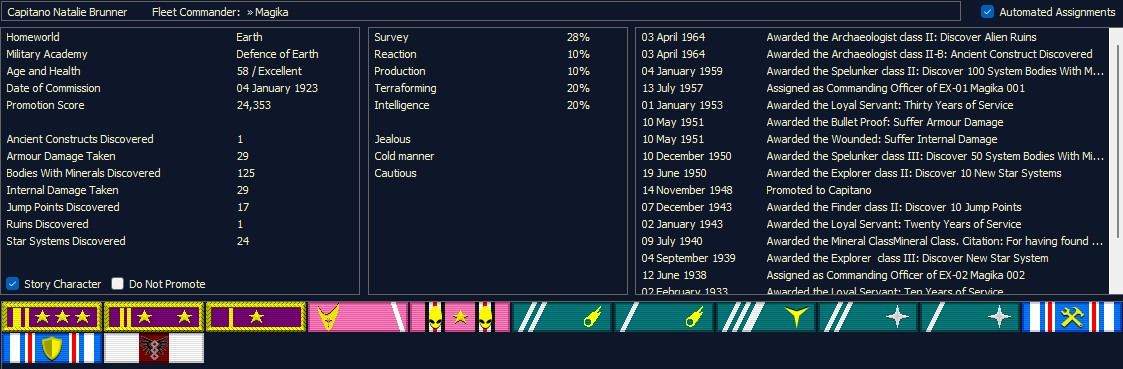
Capitano Natalie Brunner (after her was named Brunner Outpost in 86 Geminorum II)

Capitano Natalie Brunner of Magika 001

Capitano Natalie Brunner of Magika

Captain Brunner commands Magika fleet, one of the first survey vessel to operate beyond the Sol system. Under her leadership, the ship has discovered numerous valuable mineral deposits and rare planetary bodies. She also survived a Rakshas attack while operating near a colonial outpost, further cementing her reputation.

Her record speaks for itself:

  • 123 celestial bodies surveyed with mineral discoveries

  • 16 jump points discovered

  • 22 star systems explored

The Magika 001, under Captain Brunner’s command, has traveled farther than any other vessel in Axis human history and has already become a legendary ship of the Empire.

image

Speaking of combat awards, Captain Arkadiy Filippov, commander of the Corvette P-Beam stationed in the Tafel-Stromberg system, has been credited with the destruction of three enemy ships (31,578 tons) and numerous additional combat distinctions. For his actions, he earned the “Hero of the Nation” medal, becoming the first recipient of this prestigious honor.

Akradiy Filippov, commander of Corvette P-Beam

Akradiy Filippov, commander of Corvette P-Beam

35 years old Capitano Inoguchi Masaari (Renegade Mk.3 002) scored even more victories (7 ships destroyed), and 84.228 military tonnage destroyed.

Capitano Inoguchi Masaari

Capitano Inoguchi Masaari

Lieutenant Takahiro, aged 37, also deserves special recognition. As commander of the Guerriera, a fast corvette built with alien technology, he has rendered outstanding service against Raider forces, destroying three enemy ships for a total of 42,084 tons.

Takahiro

Tenente Takahiro, hero of young Axis students

Talking about ground forces, we can’t forget veteran Sergente Walter Gerrich. Hero of boarding activities with 6 succesful Boarding Combat. In service since 1933.

Navy ranks:

  • Ammiraglio ADM
  • Vice Ammiraglio VADM
  • Commodore COMM
  • Comandante COM
  • Capitano CAP
  • Tenente TNT
  • Cadetto CDT

Ground Force ranks:

  • Generale
  • Colonnello
  • Tenente Colonnello
  • Maggiore
  • Lungotenente
  • Maresciallo
  • Sergente

:brain: Imperial Doctrine

After 27 years of expansion, the ideological direction of the Empire is unmistakable:

  • Aggressive expansionism

  • Increasing militarization

  • Implicit belief in human supremacy

Logistic is setup, minerals are coming on earth and despite the industries are growing up, fuel is not a problem (for now), thanks to 11 gas stations (check system map above)

On the Edge of a New Era

By 1960, the Axis Empire is no longer a planetary civilization.
It is an emerging interstellar power, forged in war and driven by industry.

Yet questions remain:

  • Were the Rakshas only the beginning?

  • Are the Raiders truly a minor threat?

  • What lies beyond the still-unexplored systems?

One thing is certain:

the expansion will not stop.

4 Likes

Raid in Luhman 16

On December 12th, 1960, at 21:25, an alarm sounded at the Alien Activity Monitoring Center on Luhman 16 B-1. Back in the 1940s, Axis Empire had installed a tracking station on this inhospitable and barren world. For the first time since its activation, the system detected hostile activity.

A single enemy destroyer, identified as XX Niobe 013, belonging to the Raider faction, was detected at a distance of approximately 12 million kilometers from the planet, traveling at 5,848 km/s.

The vessel was immediately classified by Earth Command as hostile, a Raider scout, likely scouting for vulnerable colonies or civilian traffic to kill.

The Luhman 16 system, located just 1 jump to Sol, contains no colonies or mining operations. However, it serves as a critical transit corridor for cargo vessels and colonization routes.

Securing the system was therefore an immediate priority.

21:25 of 12 december, Raider scout contact in Luhman 16

Scramble Order

At 21:35, a dispatch from Solar Command ordered the immediate deployment of Karlstad Fleet α T, under the command of Tenente Leonhard Seeling, aged 37, with no prior combat experience.

The fleet consisted of three Karlstad T-class destroyers, a modified variant of the standard Karlstad design.

Unlike the conventional model, the Karlstad T was equipped with:

  • 10 fixed box launchers (size 24)

  • Capable of firing 10 :club_suit: Capital Torpedo-24

  • High strike payload

Together, the three ships could unleash:

30 Capital Torpedoes — equivalent to 720 nuclear warheads

However, this firepower came with a critical limitation:

Once expended, the ships required a full return to port for rearmament.

As a precaution, two Renegade-class cruisers equipped with alien tech were also ordered to move toward Luhman 16, in case additional hostile forces were present.

While Imperial forces were en route, the Raider vessel XX Niobe 013 approached the monitoring outpost, entered orbit, and landed on the planet. Curiously, it did not engage the installation.

The behavior suggested a reconnaissance operation, possibly investigating the barren and uninhabited world.

After approximately 7 hours of travel, at 04:51 on December 16th, Imperial forces reached the Luhman jump point.

  • Karlstad α T entered the system first and rush to the contact

  • Active sensors remained offline during approach

  • The Renegade fleet was ordered to hold position at a central waypoint

As the Karlstad destroyers closed in, the enemy vessel detected their presence and attempted to disengage.

At thermal sensor range, Tenente Seeling gave the order:

Turn on Active Sensors. Prepare torpedo launch.

Only one Karlstad T of the three was ordered to fire the opening salvo.

  • 10 Capital Torpedo-24 launched

  • 2 penetrated hits confirmed

Despite the low hit rate, the impact was sufficient to cripple the enemy engines, reducing its speed to 2,924 km/s.

Seeling immediately ordered a second volley.

:collision: Kill Confirmed

With the target slowed, hit probability increased dramatically (97%).

  • 10 torpedoes launched

  • 9 direct hits

The Raider destroyer was completely annihilated, engulfed in a massive explosion and destroyed in open space.

Promising 23 years old Tenente Yaroslav Marakov, commanding officer of Karlstad T 001, was credited with the kill (his first one).

He, along with the other commanders and Lieutenant Leonhard Seeling, were awarded the:

“Raider Small Operation Award”

for the successful clearance of hostile forces in the Luhman 16 system (despite the overkill).

Operational Assessment

Imperial forces remained in the system for approximately 30 days, with no further enemy contacts. After securing the area, all fleets were ordered to return to Sol, refuel, resupply and reload torpedos. However, the operation raised important strategic considerations:

  • 20 high-cost Capital Torpedoes expended

  • only 1 enemy scout destroyer destroyed

Imperial analysts concluded that this level of firepower was inefficient for small-scale engagements.

As a result, the High Command recommended the use of the standard Karlstad-class, equipped with more quantity, and less quality. And able to shoot for longer engagments:

  • Torpedo 6 (T)

  • 8 smaller launchers (size 6)

for future anti-Raider operations is also good to use long range beam ships, able to kite enemies (look at Corvette P-Beam fitting above).

A comparative cost analysis of the two Anti Ship missile systems follows in the attached report.

AS Torpedo 6 (T). Chance to hit per speed: 3,200 / 6,400 / 12,800
AS Capital Torpedo 24. Chance to hit per speed: 3,750 / 7,500 / 15,000

Torpedo 5 is used by fighters, it’s the first AS torpedo missile designed
Missiles 1 and Missiles 0.3 are Anti-missiles, at the moment we haven’t yet tested them

Good to see a new AAR here and welcome to the club! If I can offer one suggestion, it is to not mix ChatGPT/LLM written stuff with human written stuff. It’s pretty obvious which segments you wrote and which were written by ChatGPT and the difference is a little jarring. I would recommend to use LLMs only as a proof-reader!

Also, Italy dominating the Axis empire? That is amazing!

3 Likes

Hey @Garfunkel
I really appreciate your feedback, thanks a lot!

I actually wrote the content first in my native language (Italian), and then used AI in some parts to make it more fluent but in some part it changes style too. You’re right, next time I’ll probably use it only for translation, so I can keep a more consistent style throughout. I would like to create stories but not with tons of text, will discourage people to read it.

I love the game and how it naturally drives you to create stories. I’m already planning a few more reports about colonies, industry, and fleet composition.

Also, I’m not sure if it’s possible: but I’d like to make this AAR more interactive and involve the community in guiding the Empire’s decisions. For example, it would be great to run polls, like deciding which region of space to explore or expand into next.

I just noticed that there’s a poll tool available here on the forum, so I might try that for the next report :star_struck:

Would you like to contribute to this campaign by voting on the Empire’s decisions as the story progresses?
  • Yes
  • No
  • Not sure, I’d still read it anyway
0 voters

Meeting of the Grand Council

May 8th, 1961. Meeting of the Grand Council of the Axis, Rome. Palazzo Venezia.
09:15. Among the most influential officers at the table we have:

Sato Hirofumi, Grand Admiral and Duce of the Axis (77 years old), in service since 1933
Jochen Scheele, Scientific Director of the Outpost 42 Laboratory (Monaceri)
Natalie Brunner, Commander of the Magika Exploration Fleet, veteran explorer
Bastian Bier, Admiral of Naval Control
Mayuzumi Kiyotsuna, Captain, Operational Director of Industrial Operations
Renzo Bersanti, Freight Transport Command
Sasaki Buntaro, Governor of Outpost 42 Logi Lab at Monoceri-A II
Svyatoslav Timofeyev, Governor of Dwarf Colony at Alpha Centauri - A III
Andrea von Aulbach, Governor of the Sol Sector

note: no IA used for this narrative text

The great hall of the Axis Council is composed of white marble walls, with wide and tall transparent windows that let the morning light stream in bands. The twelve delegates of the Grand Council of the Axis take their places in the spacious chamber, sitting around the large oval table. They are all waiting for the signal from the Grand Admiral, the Duce, to begin proceedings

At the head of the table sits Sato Hirofumi, Grand Admiral and Duce of the Axis, 77 years old. For years there had been rumors of a succession due to his health problems, yet the Duce still appears highly focused, never granting too much familiarity to his officers, and in his decisions, since the beginning of the Era of Expansion, he has always appeared wise and resolute. The people trust him also because in these 28 years of rule he has never faced any open crisis, neither military, nor economic, nor diplomatic. Hirofumi is admired and respected as well by his officers. The Duce Hirofumi stands a great transparent window that fully reveals the Colosseum. An immense monument still intact, symbol of a civilization of centuries ago, from which the Axis draws inspiration, once an arena of epic battles among Terrans.

“Ave, councillors. Our meeting may begin.” “First of all, I would like to hear the report from the Director of the Monclave laboratory, Jochen Scheele.”

Scheele, 49 years old with over 122 scientific works on his record, clears his throat: “Ave Duce, our research is proceeding very quickly. As requested we have already researched and developed projects for the new radars, thermal radar models and Marconi active sensors are ready to be installed on our frigates.” “Larger Gamma shields compared to previous ones have also been developed and can be used. We are also working on the first automatic anti-missile defense systems (Cisw-60) and new, larger holds for missile transport on ships.”

“Thank you Mr Scheele, I would like to know instead the status of the designs for the new ships. Mr Razan, have you handled this?” “Yes, Duce,” replies deferentially Kajwara Razan, chief scientist of the Propulsion Division and director of new ship projects. “We have already transmitted the new designs for the Karlstad Mk2 and for the single Guerriera Mk2. The Beam Corvettes can also be upgraded to the new version. The ships will mount new missile targeting systems with greater range. The newly designed Marconi sensors will be fundamental to detect more precisely and in time raids on the colonies by Raiders. We have also worked on new ship concepts, they are only ideas on paper for now, we worked on new destroyers, cruisers and a battleship. We await guidance from the Council.”

Defense ships, distribution between the Solar System and other colonies.
Report made by Commodoro Connor Barry and Commander Liv Lundstrom

Fleet defence in May 1961

Defense Fleet – Sol
1 Frigate Carrier Hangarina (9,400 tons), 11 Frigates Karlstad (76,000 tons total), 2 Cruisers Renegade (72,000 tons total), 1 Commercial Carrier Asmara (32,000 tons), 1 Stationary Hangar Base (19,500 tons)
Total Fighters: 43 R-Wing II, 4 Pathfinder, 5 FAC Boarding B-2, 4 Fighter Tankers, 6 Torpedo Fighters

Defense Fleet – New Delhi (Procyon System)
4 Corvettes P-Beam (17,000 tons total), 1 Frigate Carrier Hangarina (7,800 tons) + 4 Bombing Fighters

Defense Fleet – Monaceri
2 Corvettes P-Beam B-2 (8,500 tons total), 2 Frigates Karlstad (14,000 tons total)

Defense Fleet – Outpost 61 (61 Hydrae System)
2 Frigates Karlstad (14,000 tons total), 1 Frigate Guerriera (9,900 tons), 2 Frigate Carriers Hangarina (18,800 tons total) + 8 Bombing Fighters

Defense Fleet – Iogawa (Proxima Centauri System)
3 Frigates Karlstad (21,000 tons total), 1 Frigate Carrier Hangarina + 4 Bombing Fighters

Defense Fleet – Capri (DX Cancri System)
4 Frigates Karlstad (28,000 tons total), 1 Frigate Carrier Hangarina (7,800 tons) + 4 Bombing Fighters

Fleet – Tafel-Stromberg (Gamma Carinae System)
2 Corvettes P-Beam (8,500 tons total)

Defense Fleet – Luytens
2 Frigates Karlstad (14,000 tons total)

Defense Fleet – Lambda Reticuli (Comet 6 Escort)
1 Frigate Carrier Hangarina (7,800 tons) + 4 Bombing Fighters

Defense Fleet – Brunner Outpost (Geminorum System)
1 Hangarina (7,800 tons) + 4 Torpedo Fighters

Ships total: 393.800 tons
17 Karlstad (frigate)
5 Karlstad Anti Missile (frigate)
3 Karlstad Torpedo (frigate)
8 Hangarina (carrier frigate)
8 Corvette P-Beam (corvette) *with alien tech
1 Asmara carrier (carrier)
1 Hangar base (static carrier)
1 Guerriera (frigate) * with alien tech
2 Renegade (cruiser) *with alien tech

Fighters-Fac: 41.700 tons
Total Defence Navy Tons: 435.500 tons

Total survey fleet
9 Survey ships Magika of 106.200 tons

New caetgory convention name
500: Fighter
1000: FAC
1000 to 5000: Corvette
5000 to 10000: Frigate
10000 to 15000: Destroyer
15000 to 25000: Cruiser
25000 to 40000: Battlecruiser
40000 to 100000: Battleship

New frontiers
“Thank you Mr Razan, I’ll take a look at the reports. We will soon take a decision on how to develop our defensive and offensive fleets”. Now I would like to know where we stand with exploration and whether we have news from the southern and northern borders of the maps. Captain Brunner?"

“Good morning Duce, always at your service.” Captain Natalie Brunner in full naval uniform has a youthful appearance despite her 55 years. Slender figure, icy blue eyes, she keeps her blonde hair tied behind her head. Medals and decorations gleam on her chest. Her voice is very soothing. “We have explored the systems around the Draconis region, in the south of the Empire. To the north there is the possibility of pushing beyond ‘70 Eridani’. None of our exploration fleets has encountered opposition, nor neutral life forms. From the data we have, the southern cluster seems more promising, both in terms of gas and minerals. We await your order on how to proceed.” Brunner hands the new map to the Duce, who takes it, observing it

“Very well, thank you very much. Certainly Pi Ophiuchi must be completely colonized. And the western side also still seems unmapped. We could also go beyond Omega Ceti. For the moment we must strengthen and consolidate the population in our young colonies. We will not stabilize other jump points except to reach exceptional planets, it is too risky to leave too many access gates open. Only after consolidating ourselves will we be able to think of expanding. Exploration must not stop and neither must the research of new ships. We cannot think of having fleets made only of frigates and corvettes”

“Kiyotsuna order new mining and gas extraction stations. We will truly need them. What is the current situation?”

“Honor to the Duce”. Mayuzumi Kiyotsuna hold many paper in his hands. “Gas extraction operations are proceeding well. We have 7 stations at Proxima Centauri III, 3 at Hydrae, 1 at Geminorum. We produce about 25 million fuel per year.” “I guess we can reach at least 40 million of fuel per year”. “The main mining operation is at Hydrae, with a fleet of 11 extraction ships. But resources are gradually declining. In the Solar System we have 5 stations working full speed at Von Biesbroeck. One station had been lost two years ago during the assault of the Red March, but we replaced it already. Then there is Operation Comet 6 at Lambda Reticuli, the incredible recovered alien station manages to extract many minerals. We bring a lot of material on earth, who knows if one day we will be able to build a similar marvel. Here is our mining situation Admiral, and the extraction fleets disposition”. The Duce takes the documents and analyzes them carefully before to speak again.

“Bersanti, it is your turn. Tell me how logistics between colonies and fuel transport are proceeding.” “Honor to the Duce, we have 4 tankers that each year bring gas to the ports. A tested and efficient system. Another 3 tankers on standby in case of emergencies, shortages, or support to fleets. But for now our frigates do not consume much, apart from the two Cruisers, Renegade, with alien technology. Regarding transport, the Cargo ships have almost completed the transport of a spaceport to Pi Ophiuchi II, where we already have nearly 7 million citizens. The salvager ships have returned with the remains of the last raider destroyed at Luhman 16, the two Tugs are ready if needed to move new stations”.

“Very well. We must now take stock of terraforming works. It is necessary to proceed quickly, otherwise we will not be able to start production outside Earth, and we will have a shortage of colonists. I need to know from you, Buntaro, how things are progressing at Outpost 42, at Monoceri?”

“Duce, we have 65 terrestrial terraforming units. We are adding Aestesium gas to raise temperatures. Oxygen is already at optimal level, but we must bring the total below 30%, it is now at 31.2%. It will take several years, perhaps 3, 4 years. We are proceeding at maximum speed.” “Timofeyev, what can you tell me about Alpha Centauri - A III, it has been 5 years since you began terraforming the dwarf planet. I expect results soon. Alpha Centauri must become our outpost in the north.” The young Timofeyev, 31 years old, trained at the Governors’ Academy of Luna, has a typical lunar accent that reminds everyone of Russian.

“Duce, we are currently limited by the number of colonists, we lack 2.5 million workers to reach 100% efficiency. Fortunately the planet is small, the 24 terraforming platforms are working day and night. We are adding oxygen while the water vapor is gradually condensing, soon we will have sufficient water. I believe that in two years, if we bring more colonists, we will be able to terraform the planet”

“Good, carry on. Then we will have to continue terraforming other bodies in Alpha Centauri, we just have to move installations, and then it will be the turn of Iogawa, we need mines there and I want more workers available.” Hirofumi pauses for a long reflective moment, stands up from his chair placing both hands on the table. “The meeting of the Grand Council may be considered closed for today.” “We now proceed to the voting phase. I ask you gentlemen to indicate your preference on government priorities. Once the vote is cast, I will review the results, study all your reports and update you via holograph with more specific orders. Thank you all, you may vote and return to your duties. Ave”

The officers stand and salute: “Ave”, then begin to press several keys on the meeting table, meanwhile the Grand Admiral has already turned his back, he is leaving the hall with a slow pace, before opening the door he casts a glance to his right, toward the large window where the Colosseum stands.

What is the indication from the vote of the Grand Council?
  • Focus on aggressive border exploration build new Magika ships
  • Focus on producing defensive fleets of destroyers and cruisers
  • Produce more terraforming modules, consolidate existing colonies
  • Produce more mining and gas stations and stockpile minerals and gas
0 voters

Be part of the story
*note: anyone who votes or reads this AAR may ask me to impersonate a character within the story, your character will become part of the narrative and will appear in events and other reports. Reply to this post or send me a message with your character name (be coherent with the story, let me know name and surname) and chosen role. You can choose from:

-fighter pilot defence (Bombing or R-Wing)
-fighter pilot logi or scout pilot (Pathfinder or Tanker)
-cargo pilot
-troop transport pilot
-young colony governor
-salvager pilot
-tug pilot
-gas station commander
-mining station commander
-mining ship pilot
-young scientist
-young ground force commander

as your character gains experience, you may be promoted and eventually take command of a proper warship, and maybe one day partecipate to the Ground Counsil of Axis!

3 Likes

Push the Boundaries

Axis Empire continues its expansion toward the most distant frontiers. The three Magika exploration fleets, composed of 9 ships in total, have been reinforced with two new exploration vessels that will operate independently. The Council’s vote was clear: it was necessary to invest in finding new resources, deciphering the mysteries of the universe, and bending them to our advantage.

The two new Magika ships will be deployed at the borders: one in Alpha Centauri, where the population can now support ships up to 70,000 tons, and the other in the deep south, beyond 81 Draconis, as soon as the new colony is able to host adequate maintenance facilities. These two exploration ships will be based directly in these new colonies. The other Magika fleets will also be gradually assigned to the most remote frontiers, to the East and to the West.

Total Magika exploration ships: 11 + 7 scout fighters (128,000 tons total)

August 30th, 1962 – Incredible Discovery in WX Ursae Majoris

Captain Moa Berglund, commanding the Magika γ fleet, and her men have just discovered a jump point in Iota Ursae Majoris, on the south-eastern edge of the known maps. Despite limited supplies and scarce fuel, Berglund orders the fleet to make the jump and take a look at the unexplored system.

The sensors immediately reveal a place rich with celestial bodies: more than 60 planets and moons, plus hundreds of asteroids within extraction range. The most interesting planet is Ursae Majoris-A III, barren but with the potential to be colonized.

From Astronomical Command, Commander Orlando Abbitt orders Berglund to scan the planet, search for possible ruins, and return immediately at the base for resupply. Berglund’s eyes shine as the planetary scanner reveals its results. “There are ancient ruins!”

“Go down there immediately and investigate.”

Cadet Sigrid Pommer, aboard the Pathfinder fighter with his 3 crewmembers, dives through orbit and activates the sensors. No enemy ground units are detected. The ruins appear well preserved: a partially intact colony of some unknown civilization.

Magika γ completes the scan and begins its return to Earth. The new ships under construction, or other fellow explorers, will finish the examination of this promising system.

From ground command, Admiral Duce Hirofumi is informed of the important discovery. The immediate deployment of personnel and ground forces is ordered, commanded by Maggiore Marco Skorzeny, a rude soldier but also a Xeno artifacts expert. Transport units with a jump gate ship are sent toward WX Ursae Majoris, carrying around 120,000 tons of troops on board: 70 STO air defense units, 45,000 infantrymen, 25,000 assault and defense vehicles, 10,000 constructors, and 20,000 archaeologists. Arrival is expected during the first months of 1963.

The media of the Axis report the news of the archaeological discovery with fervor and excitement; the hope is to uncover rare alien artifacts and technologies that may provide a major boost to the expansion and defense of the Empire.

September 12th, 1962 – Rats in Luhman 16. Setting traps for raiders

Another sighting of a single Raider ship in Luhman 16, showing the same behavior observed two years earlier. The Raider scout lands on the uninhabited planet. The Karlstad T and Karlstad AM fleets are immediately deployed from Earth, just 1 jump away.

After a few hours, the two ships intercept the enemy contact without difficulty. The Raider attempts to disengage, but fails. During the attack, Warhead-1 missiles are tested first, used as anti-missile weapons but still capable, when launched in mass, of penetrating unshielded and low armor hulls. Shortly afterward, a Warhead-24 is launched from the Karlstad T, striking the enemy ship’s structure and causing it to explode.

Another victory for Lieutenant Yaroslav Makarov, a twenty-five-year-old officer with a promising future: 2 confirmed victories and 21,000 tons of enemy ships destroyed.

A trap!

Given the repeated Raider activity in Luhman 16, it is decided to organize a trap. Instead of ordering the recovery of the wreck, an exploration ship (Magika) is sent to cover the surrounding area with probes and sensors. In addition to the planet’s long-range detection system, the probes deployed by Magika will now also be able to detect any enemy approach in the area.

The hope is that the wreck will attract new Raiders. Luhman 16 is easily reachable from Earth’s spaceports: as soon as the sensors detect something, new interception fleets will be able to launch and, within a few hours, make a feast of the enemy. Will the trap work?

New Terraforming Colonies. November 1962

Incredibly, both Monoceri A II and Alpha Centauri A-III (Dwarf Colony) have been terraformed! An extraordinary success for the environmental engineers of the Axis, who managed to make these two systems habitable earlier than expected.

The small planet of Alpha Centauri A-III will become a key outpost for the northern colonies: it will be able to host 59 million people and will become an excellent mining world. We just have to wait few months that Water Vapour will condense as water on soil, then the work will be done. Terraforming modules are about to be transferred to Alpha Centauri B-III, which will receive the same fate as the twin planet of star A.

On Monoceri, the population can now reach 389 million inhabitants; it will therefore be possible to strengthen research with new laboratories and exploit the logistical bonus provided by the structures discovered on the planet. Work is still ongoing on the addition of Aestusium to increase the minimum temperature, which remains too low (-63 degrees). It will probably not be possible to fully terraform the planet, as it has an irregular orbit and extremely unstable temperatures, ranging from 30 degrees down to -63.

It will, however, certainly be possible to optimize infrastructure use and drastically reduce the number of facilities required. Meanwhile, the excess housing units, both on Alpha Centauri A III and on Monoceri, have been redirected toward Alpha Centauri B-III and toward Callisto, one of Jupiter’s moons, where the Axis will attempt to create a habitable environment in order to extract the numerous, but otherwise difficult-to-access, mineral resources.

2 Likes

The Silent Frontier

May 17th, 1964. The Supreme Admiral of the Axis and Duce, Sato Hirofumi, turns 80 years old. In New Delhi, in the Procyon system, a great public celebration fills the streets and spaceports of the colony: imperial banners, military parades, official speeches, and thousands of citizens gathered to pay tribute to the man who, for more than thirty years, has guided the destiny of humanity among the stars.

Despite his increasingly fragile health, Hirofumi still appears lucid, present, and perfectly aware of the weight of his decisions. The medals and decorations gleam on his chest, the latest being The Ancient Wise Regent, awarded by the Representatives of the People for thirty years of prosperous rule, as he watches the crowd with his usual stern gaze.

Since 1933, the day plasma engines were discovered thanks to the study of the craft recovered during the Magenta Incident, every strategic decision of the Axis has passed through his hands: he organized the defense of Earth, led the first great colonial expansion, supervised the construction of the fleets, and imposed a simple but iron doctrine — always explore, always advance, but never lower your guard.

The Empire must grow, but it must also survive.

Everyone knows that Hirofumi’s time is not infinite. In the corridors of the Grand Council, people now speak openly of the future succession, yet the Duce has still not named an heir. Perhaps he is still waiting for something. Perhaps he wishes to see for himself how far mankind can push into the stars. Or perhaps it will be the people who choose.

Beyond the Raiders, the predatory race that continues to infest trade routes with swift incursions and sudden disappearances, humanity has also encountered the Rakash: a harsh, aggressive, deeply territorial species. They fought to the very last to defend three planets that now belong to the Axis. No communication, no surrender, only war.

Recently, the autopsy of a Rakash body recovered after a ground battle revealed valuable data about their habitability parameters: temperatures between -57° and +67°, oxygen levels between 0.02 and 0.29 atmospheres, and gravitational tolerance up to 2.93G. Information that tells much about a people accustomed to surviving in hostile environments.

Meanwhile, the extraordinary Magika exploration ships — now risen to 13 operational units — continue to push where no human being has ever gone. Fast, light, tireless, they have become the true symbol of the new Era of Expansion.

The latest great discovery bears the name of Captain Natalie Brunner.

In Rho Sculptoris II, west of the mapped regions, her fleet discovered ancient ruins: the remains of an unknown city, cyclopean monoliths, and structures that seem to belong to a far more advanced civilization. Some buildings resemble research laboratories, while others remain completely indecipherable.

A similar discovery also took place on the southern front, in WX Ursae Majoris-A III, where a partially intact abandoned colony was found. No fewer than 296 installations are still present on the surface and are slowly being brought back to light by teams of builders and archaeologists.

As if that were not enough, on Fomalhaut III an old alien outpost was discovered hidden inside a cave stretching for kilometers: an ancient observatory, perhaps a surveillance base, perhaps something even more important.

Archaeological units are working day and night. On Fomalhaut III, seven brigades of archaeologists and two construction brigades are already operating, protected by two infantry divisions. Another brigade will soon be transferred to Rho Sculptoris, while on WX Ursae Majoris several construction teams are already at work extracting the valuable installations. To avoid unpleasant surprises, three infantry divisions, assault vehicles, and no fewer than 76 STO orbital defense units have been deployed to protect the colony.

Every ruin could contain a technological treasure. Or a danger.

Exploration has also revealed numerous promising systems from a mining perspective: 1 Phoenicis, Fomalhaut, and several new clusters still under analysis show planets rich in resources and favorable environmental conditions for future colonization.

Meanwhile, the trap prepared against the Raiders in Luhman 16 continues to remain silent. No signals. No movement. The last recorded incursion now dates back sixteen months, to September 1962.

This reassures no one. What are they plotting against the Axis? Where will their next incursion strike?

Meanwhile, nearly all colonies continue to grow, especially the two most recently terraformed: Outpost 42 Logi, on Monaceri, and Dwarf Colony on Alpha Centauri-A III. New mines are being transferred there, along with more and more specialized workforce.

Callisto and Alpha Centauri B-III are rapidly being converted into breathable worlds. In both systems, the plan is clear: install mines, develop infrastructure, and transform them into industrial pillars of the Empire.

Great attention is also being directed toward Proxima Centauri II, where the mineral deposits are extremely promising. Once a sufficient population is reached, the massive deployment of mines could guarantee a flow of resources capable of sustaining the expansion of the Axis for decades.

The Mineral Courier ships travel endlessly from one colony to another, carrying minerals back to Earth like vital arteries of an ever-growing organism.

For now, only New Delhi and Proxima Centauri possess their own factories and continue, without interruption though still slowly, the production of housing infrastructure, industries, and new strategic facilities.

The Empire grows.

Who knows if somewhere in the universe there is other intelligent life?

Situation of resources on 1964

  • Total colonies: 17
  • Mineral stock on Earth: 1.737.980 Average stockpile 150.000 per mineral
  • Fuel on Colonies: 458.000.000
  • Mps at Colonies: 598.000
  • Naval Tonnage: 641.000
  • Naval Shipyard Capacity: 652:155
  • Commercial Tonnage: 5.500.000
  • Ground Forces: 912.157
  • AM total: 391
  • Mine: 1004
  • Terraforming Installation: 101
  • Research Facility Earth: 51
  • Research Facility Outpost 42 Logi Lab Monocery: 8

Shipyards situation on Earth

1 Like

Disaster in Rho Sculptoris

Echo Colony, Axis Outpost - The ruins of an ancient city on Rho Sculptoris II had drawn, for months, teams of engineers, archaeologists, and construction units. Preliminary studies had identified, with reasonable certainty, the Echo civilization: symbols, language, and architectural patterns had been partially deciphered. 137 abandoned installations lay buried beneath layers of dust and rock, ready to be recovered.

Unknown machinery, intact structures, complexes that seemed to be laboratories or research centers — everything suggested discoveries of immense value.

On November 5th, 1965, as a precaution, all archaeologists were evacuated. Only construction brigades and two security divisions remained on the colony: one infantry and one armored vehicles, for a total of approximately 2,700 operational units, nearly 50,000 tons of ground forces.

Work continued without incident. Until that night.

01:28, November 7th, 1965. A date the Axis would not forget.

The night is still over Rho Sculptoris. A thin wind lifts fine dust across the excavation sites. Then, suddenly, a deep rumble. Not an explosion. Something deeper. A sound that seems to rise from beneath the surface.

Boris Nikitin, 33 years old, Marshal and commander of the vehicle division, wakes with a start.

“What was that?”

When he steps out of his container, he finds Sergeants Fritsch and Codazzi frozen, staring into the valley.

Two kilometers out, beyond the excavation perimeter, something is moving.

At first, shadows. Then metallic reflections. Then shapes.

A solid line of massive mechanized units advances slowly. Metallic colossi, reminiscent of centurions, with heavy limbs and propulsion systems in place of arms. Their movements are steady, relentless. Their tracked feet crush the ground, raising clouds of dust with every step.

Behind them, more machines emerge from the darkness: walking missile platforms, articulated structures, oval armored forms like massive eggs. No radio emissions. No signals. Only movement.

ground force signature...

“To battle stations!” Nikitin shouts. “Wake everyone! Defensive perimeter, now! Barricades, covering fire, move!”

He turns to Seargeant Codazzi: “Contact Earth command immediately. Full alert. Unknown units advancing. Origin: the ruins.”

“Sir… we estimate at least five thousand units. Eighty thousand, maybe one hundred thousand tons total, probably more.”

He doesn’t finish. A flash in the sky. Then impact.

A missile strikes one of the STO defense battalions a few hundred meters from the camp. The explosion lights up the valley. Men and structures are swept away in an instant, like ants moved by a gust of wind.

“Get in there and search for survivors, evacuate the wounded. Honor to the fallen—hold your positions!”

Nikitin runs toward the command center as sirens begin to howl.

The Axis forces respond with discipline. Within minutes, a defensive line is formed. Improvised positions, vehicles deployed, infantry in cover.

They do not know what they are facing. The first waves strike with surgical precision. Missiles, energy bursts, a steady advance. The mechanized units do not slow, do not hesitate, do not communicate. They fight like a perfect machine. For six days, the colony becomes a battlefield.

Defenses collapse one after another. Fortifications are breached. Counterattacks slow the advance, but never stop it. Light assault vehicles manage to break through segments of the enemy line, destroying units at close range. But one by one, Axis forces are overwhelmed.

On November 12th, at 11:46, the last pockets of resistance are wiped out.

Before the end, however, the Axis manages to inflict significant losses: 210 Centurions destroyed, one Constructor eliminated, one Decurion AA Mech taken down, 6 Praetorian Combat Mechs and 33 support units neutralized.

It is not enough. Enemy forces still number around 6,000 units, totaling an estimated 80–90,000 tons. And now they control the colony. They are guarding something.

November 13th, 1965 — Axis Grand War Council

For the first time, the Axis faces a superior enemy in ground combat. The new entities are designated “Sentinelle.” They do not respond to communication attempts. They show no sign of individual autonomy. They are defensive units, emerging directly from the ruins.

“Perhaps we did not discover a city,” someone murmurs in the chamber. “Perhaps we opened a door.” High Admiral and Duce Sato Hirofumi listens in silence. He is 81 years old, yet his voice remains firm.

“We will rebuild the army.” No hesitation. “We will use our most advanced technologies. Offensive and defensive. We will not return unprepared.”

He rises slowly. The room falls silent.

“We will land with a force at least four times their number. I want four hundred thousand tons of elite infantry and armored assault units.” A pause. “This time, we will retake the colony without suffering unnecessary losses.”

Then he turns to the naval command. “First, the Renegades. Our finest ships. Their alien shields will be the key. They will sweep the orbit. If there are defenses, they will destroy them.”

A final glance across the chamber. “I will not send men to die without cover.” Silence.

“Honor the fallen. Regain clarity. Tomorrow, the Renegades depart.”

Then, addressing the training command:

“Rebuild an army worthy of facing these Sentinelle, we need at least 400.000 tons.”

A brief pause.

“And take back Rho Sculptoris.”


Ground forces designed for the counter-offensive: Panzer Armata and Infantry Sturm Armata

Meanwhile, exploration over the past year and a half has progressed very rapidly.
60 known systems. 19 populated colonies

November 12th, 1965
Total population: 2,102
Automated mines: 415
Infrastructure: 55,456
Terraforming installations: 104
Spaceports: 4

Total mineral reserves on Earth: 1,778,160
Total fuel at colonies: 454 million
Fuel on ships: 213 million
MPS at colonies: 641,000

1 Like

A New Dawn and Flag History

The two Renegades, pride of the Axis space navy, cut through the void on their return course from Rho Sculptoris. Their hulls still bear the marks of battle, scorched scars that tell of a hard-fought engagement, far more difficult than expected, yet ultimately successful. The mission had been clear: eliminate orbital defenses and prepare the ground for the return of ground forces. That objective has been achieved.

The Sentinels’ STO defenses have been destroyed, reduced to drifting debris scattered across the planet’s orbit. The skies above Rho Sculptoris are now clear, ready to receive the new troops currently being assembled. Yet it was not a clean victory. A human error, seemingly minor, nearly compromised the entire operation. A bridge officer delayed (or forgot?) the activation of the Xi shields, the most advanced defensive technology of the Axis, leaving the Renegades exposed to enemy fire for a few seconds too long. Direct hits struck the hulls, causing minor damage with no crew casualties.

Despite this, the ships endured and responded with precision and force. Approximately 5,000 tons of enemy defenses were annihilated, (with some installations destroyed as collateral) but sensors confirm around 50,000 tons of enemy units remain active on the surface. The Sentinels have not been defeated. But more units are still there, silent and motionless, guarding something the Axis has yet to understand. The Renegades will return to Earth for repairs, but it is clear that the battle for Rho Sculptoris is far from over.


January 3rd, 1966 – 19:45, Rome

The sun is setting over Rome as Hirofumi steps onto the balcony of Palazzo Venezia. Golden light washes over the city’s monuments, while the Colosseum rises on the horizon, immobile and majestic, a symbol of a civilization that once ruled the world and then fell. Behind him, the Axis flag moves slowly in the evening wind.

The Supreme Admiral stands in silence. In the sky, barely visible beyond the atmosphere, the trails of departing and returning ships remind him how far humanity has come—how it has reached beyond Earth and spread among the stars. And yet, for the first time in decades of uninterrupted expansion, something has cracked: the Rho Sculptoris defeat of November 1965, with thousends of men lost.

Hirofumi reflects for a long moment. Expansion will not stop. It cannot stop. The Magika fleets are already at the edges of known space, searching for new worlds. The latest system discovered, HIP 82725, deep in the southern reaches of the maps, appears promising: a potentially habitable planet, several moons yet to be explored, and a vast asteroid belt rich in resources. Sixty-two systems are now known, and still it feels like only the beginning. Also, just next door to HIP, Xi Areae is a real promising land to colonize.

At the same time, Hirofumi knows that his own time is limited. At eighty-two years old, despite the advances of medicine and genetics, the moment to step aside is approaching. Perhaps he will retire to Alpha Centauri, one of his favored colonies, far from the weight of command. But before that, he must make a final, decisive choice: name a successor.

It is not an easy decision. The future of the Axis depends on it. The next leader must embody the Empire’s core values: order, discipline, expansion, control, and honor.

Among the most discussed names are Giancarlo Fisichella, commander of Colonial Defense, a pragmatic and tireless organizer with some combat experience; Filippov, a war hero and symbol of strength; Inoguchi Massari, captain of Renegade 002, precise and resolute, tied to the same Nipponic tradition as Hirofumi; Natalie Brunner, a veteran explorer and sharp-minded strategist, perhaps a more cautious choice; and Alexandra Au, commander of the Lunar Military Academy, a firm advocate of a more assertive military doctrine and ground intervention.

Hirofumi’s gaze returns to the Colosseum. Once an arena for battles staged for the masses, now a relic of a distant past. And yet, in truth, little has changed. Men still fight. Only now, they do so among the stars.

Whoever his successor will be, they must be ready. Because the universe is not as silent as it seems. And what happened on Rho Sculptoris is only the beginning.

The flag of the Axis

The flag of the Axis Empire was born in the years immediately following the discovery of plasma engines, when the alliance between the Germanic, Italic, and Nipponic powers evolved into a single political and military entity. It was during this early phase of consolidation, under the leadership of Supreme Admiral Sato Hirofumi, that the banner was adopted as the official symbol of the Axis.

Hirofumi, already a central figure in the construction of the fleets and in shaping the doctrine of expansion, wanted a flag that would not merely reflect the Empire’s terrestrial origins, but would clearly express his vision: a humanity destined to expand into the stars, maintaining order, discipline, and control.

The red field represents the sacrifice and military strength that made unification and the first off-world conquests possible. The white central disc, inspired by Nipponic tradition, was reinterpreted as the core of humanity — the point from which expansion radiates outward into space. At its center, the black eight-pointed cross, derived from ancient European chivalric symbols, stands for the order imposed upon the chaos of the universe, as well as the directions along which the Empire extends.

Over time, the flag has become more than a simple emblem: it is the visible expression of the Axis’ will. It flies over colonies, ships, and the most remote outposts, reminding every citizen and officer that expansion is not merely a choice, but a destiny, guided with firm resolve by Hirofumi’s hand.

1 Like

New ships, New modules and naval doctrine

February 1966. In the months following the disaster at Rho Sculptoris, research across the Axis accelerated at a good peace. The recovery of two large wrecks of unknown origin, combined with the analysis of advanced modules salvaged from Raider vessels, provided a decisive boost. What had once been theoretical became practical. What had been experimental became standard.

Shipyards expanded. Orbital docks grew larger, more efficient. And the backbone of the fleet—the Karlstad-class missile frigates—underwent a complete refit.

All units were upgraded to the new Mk2 standard: enhanced sensor suites, expanded missile payloads, and improved fire control systems equipped with electronic countermeasures. For the first time, Axis engineers achieved full design optimization, standardizing the class at a precise 7,000 tons—a milestone long pursued in naval engineering circles.

The Karlstad fleet now stands at 27 units:

  • 19 Karlstad Mk2, configured as anti-ship frigates for colony defense

  • 5 Karlstad A.M, specialized in anti-missile operations

  • 3 Karlstad T, equipped with high-damage torpedoes for defensive engagements

All ships were fitted with retargeting missiles, a new technology just researched but still never tested on battle. Longside them, the six P-Beam corvettes were also upgraded, receiving new sensors and refined beam fire control systems, making them far more effective in close-range combat..

The shipyards of the Axis have been retooled to support the construction of an entirely new generation of warships.

Two new heavy frigates, the Guerriera 061 and Guerriera 065 classes (9,000 tons), have been designed for both colony defense and short- to mid-range operations. Above them stands the Balbo-class cruiser (20,000 tons), a versatile combat platform, and its specialized boarding variant, designed for capture operations.

At the center of the new doctrine, however, stands the Dominix-class carrier.

At 50,000 tons, with 16,000 tons dedicated to hangar space, the Dominix represents a strategic shift in Axis naval warfare. It is designed to project power beyond immediate engagement ranges, deploying waves of strike and support fighters.

To support this evolution, a new fighter has been developed: the Arado. Three times more powerful in terms of damage output compared to the aging R-Wing II, it comes at a cost—double the size, 500 tons instead of 250, and significantly higher production requirements. But in the calculus of modern warfare, efficiency is measured in impact, not economy.

Meanwhile, Axis engineers have finalized the design of the Brema-class battleship (37,500 tons), a heavily shielded vessel optimized for devastating close-range engagements. Its missile-focused counterpart, the Brutus, offers a complementary long-range strike capability.

In the coming years, the Navy will focus on assembling a completely new fleet—one capable not only of defending the Empire, but of projecting force across vast distances.

Current doctrine envisions a modular fleet structure built around a 300,000-ton operational group: a support core centered on a Dominix carrier, accompanied by supply ships with MSP and missiles (Santarosa), tankers, and jump tenders, ensuring operational endurance and mobility in chase of longest missions.

A beam combat fleet, composed of Brema battleships, Balbo cruisers, and Guerriera frigates, designed for close-range engagements and sustained firefights.

A missile fleet, built around Brutus battleships, Milingo and Audace-class vessels, and supported by Karlstad anti-missile frigates, capable of striking from long distances with overwhelming firepower.

This layered approach marks a clear evolution in Axis naval doctrine: flexibility, depth, and the ability to control engagements at any range.

Research priorities reflect this shift. The Axis is now heavily investing in logistics, advanced weapon systems such as Particle Beams and Railguns, and next-generation missile technology. German and Japanese scientists are also working on improved shield systems and more resilient armor, aiming to ensure that future vessels can withstand the kind of engagements seen at Rho Sculptoris.

As of February 1966, the Axis fleet continues to grow:

Frigates and light combat ships include 27 Karlstad units, 6 Beam corvettes, 2 Guerriera 61, and 9 Hangarina-class missile carriers.

Among cruisers, 2 Balbo, 1 Balbo boarding variant, and 2 Renegade Mk3 remain in active service. The first Dominix carrier (named Shokaku) is operational, while additional ships are already under construction: a new Balbo cruiser, two Brema battleships, one Brutus-class vessel, and four Guerriera 65 frigates.

1 Like

Battle of Ulla – Sol System

1966. March 22nd, 08:16 – Sol

A sharp signal cuts through the silence of the radar screens. Contact confirmed. A Raider vessel, Niobe 030, appears north of Earth, moving at high velocity—5,831 km/s—on a direct vector toward the planet. The response is immediate.

Three newly commissioned Balbo-class cruisersAgordat, Caio Mario, and Lombardia—are dispatched at full speed to intercept. As a precaution, additional assets are deployed: the carrier Dominix, the two Renegade-class flagships, and a Hangarina missile carrier. The fleet spreads out across multiple waypoints, active sensors kept offline to avoid early detection. Then, suddenly, Niobe 030 vanishes.

The ships continue their sweep in silence, scanning the void.

20:58. A new contact from Tracking Station on Earth. Then another.

Two Raider ships—Niobe 025 and 026—appear to the northeast. Moments later, Niobe 030 re-emerges. Fighter-bombers are immediately launched from the carrier Shokaku, tasked with intercepting Niobe 030. The other two signals disappear again.

At 23:56, the Balbo cruisers close into firing range. Niobe 030 strikes first, hitting 5 shields of Caio Mario. The response is devastating: twenty Leonardo Particle

Beam III fire in unison. Sixteen hits tear into the Raider’s hull. Its engines fail instantly.

At 23:57, the boarding unit—1,000 tons of assault troops—launches from Agordat. Sergeant Thomas Howe leads the attack. The engagement lasts minutes. Twelve losses. The ship is captured. A Tug vessel, Ciclope, is dispatched from Earth to retrieve the prize.

March 23rd, 10:57. Niobe 025 and 026 reappear. Axis forces move to intercept, but the Raiders vanish once more into the void.

March 24th, 12:05

Two new contacts: Ontario 005 and 006, dangerously close to the carrier Shokaku. A Pathfinder scout is launched at extreme speed (10.000km/s). Its mission is simple: track, do not engage.

At 13:49, the scout, piloted by Cadet Livio Turci, closes in. “Earth, multiple contacts detected! Ten ships confirmed—six Niobe, two Magnificent, two Ontario.”

“Maintain distance. Draw them north. Lead them toward the Renegades.” Commander Arkadiy Filippov’s voice is calm, from Comando Ricognitori Terra he talks to the cadet. “Be calm, precise to keep distance. Everything will be ok”. He knows the Raiders. The trap is set.

“Never seen this many together,” murmurs Inoguchi Massari aboard Renegade Mk3 002. “We’re outnumbered… but not outmatched.”

14:58 - Fighter-bombers launched from Dominix strike first. Twenty Torpedo-5s launched at Niobe 025. Four hits. Limited damage. The Raider formation holds. Bombers are going back to carrier to reload

22:47 – Battle near asteroid Ulla

The fleets finally converge. The Raiders, now close to the asteroid, detect the Balbo cruisers and the approaching Renegades as active sensors come online.

The two Renegades open fire. Particle Lance 24 cuts through space. Niobe 026 is struck and disabled. Niobe 025 detonates moments later, a cloud of debris expanding into the void.

The enemy closes in—too close. At 130,000 km, a miscalculation exposes the Renegades. A barrage follows—39 hits on their shields. The damage holds. Barely ten percent of shield capacity breached. The Renegades pull back, recalibrate.

Then strike again.

Niobe 036 is crippled. Seconds later, destroyed. Niobe 033 follows. Then Magnificent 007, 008, 009—disabled in rapid succession. Ontario 006 drifts, then is finished with a final shot. Niobe 027 is obliterated. One by one, the Raider fleet collapses under relentless fire.

By 22:52, the battle is decided.

What remains is silence. And wreckage. The space around Ulla has become a graveyard—drifting hulls, shattered metal, disabled ships spinning slowly in the dark.

The Balbo B.A. moves in, boarding the survivors one by one. Minor damage is sustained during one operation, quickly repaired upon return. Six ships are captured.

Sergeant Thomas Howe records six successful boarding actions in a single day.

The Renegades claim four confirmed kills. Inoguchi Massari sets a new personal record: a total of eleven enemy ships destroyed. The battle record 6 captured ships and 9 ships destroyed. All military personnel involved in the operation were awarded a special medal: the Cross of Defense, in remembrance of March 24th, 1966, when Earth and the Solar System were defended by the brave heroes of the Axis.

In the days that follow, the Axis works tirelessly—salvaging wrecks, recovering alien modules, towing captured vessels back to port to scrap and diassemble. The largest naval battle in 33 years of Empire by the Axis ends in a decisive victory. And perhaps, a sign of what is to come. Rho Sculptoris awaits.